





Insect Behavior Chemical Library


Development of the HV-VOCs Library: A Curated Chemical Space for Volatile Semiochemical Discovery
Targeted modulation of insect behavior is an important strategy for agricultural pest management, disease vector control, and environmental monitoring. The discovery of effective behavior-modifying compounds requires not only biological activity toward insect olfactory systems, but also physicochemical properties that enable efficient delivery in the vapor phase. To support this task, we developed InsectVOC42K, a curated virtual library derived from the CDS (Chemical Database) collection and enriched for volatile, structurally suitable, and screening-ready organic compounds. The library is designed as a practical starting point for the discovery of new pheromone mimetics, repellents, attractants, and olfactory receptor ligands for semiochemical research.
This library represents a specialized chemical space tailored for researchers in entomology, chemical ecology, and agrochemistry
Verview and Rationale
The targeted modulation of insect behavior represents a cornerstone of modern integrated pest management, disease vector control, and ecological monitoring. Whether the objective is the disruption of mating via pheromone mimetics or the deterrence of vectors through novel repellents, the effectiveness of a bioactive molecule is dictated not only by its receptor affinity but by its vapor-phase kinetics.
To address the historical challenge of identifying stable, volatile, and bioactive leads, we have developed the HV-VOCs (Highly Volatile Organic Candidates) library. Comprising 42,061 compounds derived from the ChemDiv CDS collection, this library bridges the gap between traditional medicinal chemistry and chemical ecology.
Hierarchical Selection Methodology
The construction of the HV-VOCs library followed a rigorous, multi-stage computational pipeline designed to prioritize chemical stability and environmental suitability.
1. Structural Curation and Biostability
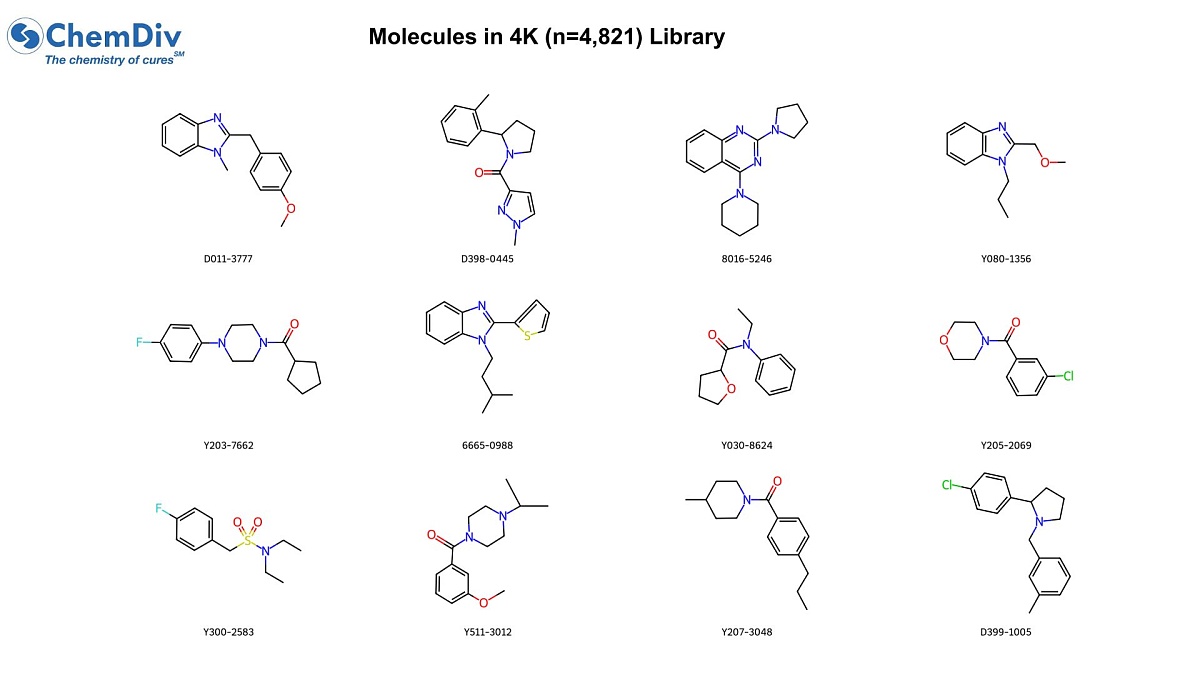
The initial dataset was subjected to stringent Medicinal Chemistry Filters (MCF). The primary goal was to eliminate "nuisance" compounds that might interfere with biological assays or degrade prematurely in field conditions. Specifically, we filtered out:
- Reactive functional groups and unstable moieties (e.g., acyl halides, peroxides).
- Known toxicophores to ensure safety in agricultural and environmental applications.
- Non-specific covalent binders, ensuring that the resulting library consists of "probe-like" molecules suitable for characterizing specific olfactory receptors.
2. Quantitative Volatility Modeling
At the core of our selection process is a hierarchical approach to estimating vapor pressure under ambient conditions (298 K). Given that experimental boiling points are often unavailable for large virtual sets, we employed the Guldberg-Guye rule to estimate normal boiling points (Tb) as a function of heavy atom count (Nheavy): Tb ≈ 100 + 25 × Nheavy
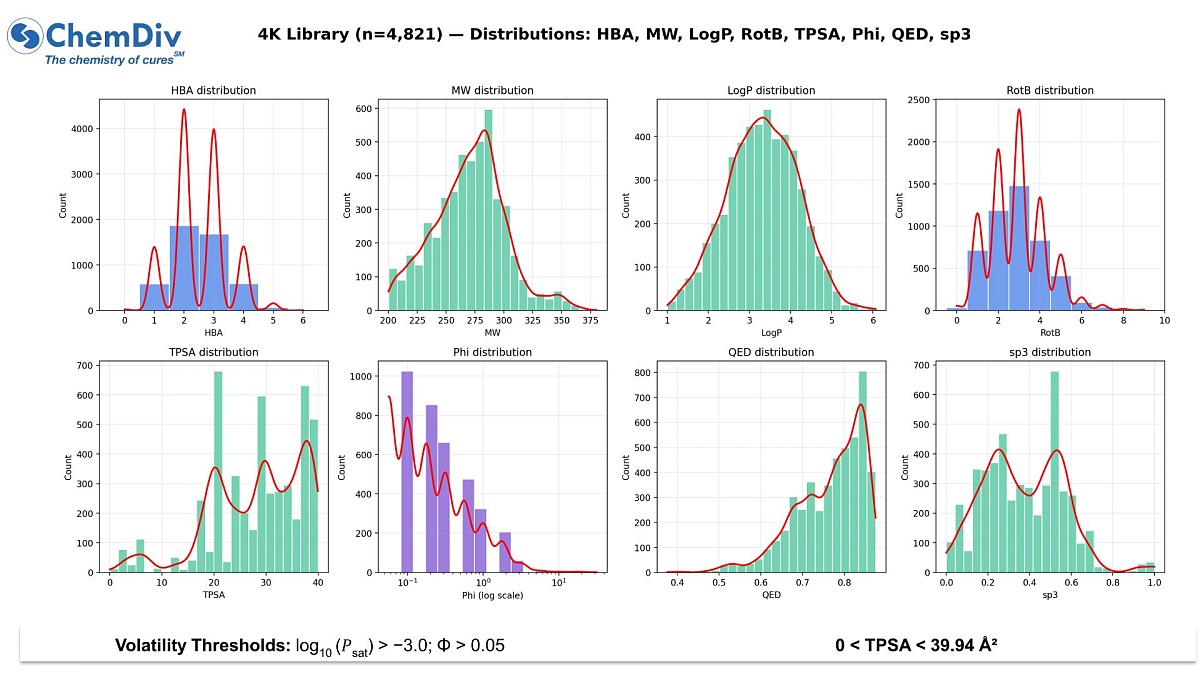
Subsequently, saturation vapor pressure (Psat) was derived using a simplified Antoine-type correlation. To ensure practical environmental persistence and effective delivery, we applied a dual-threshold filter: log10(Psat) > -3.0 (Bars), Volatility fraction (Φ) > 0.05
This ensures that every compound in the library possesses the physical properties required for spontaneous evaporation and atmospheric transport.
3. Physicochemical Profiling for Bioavailability
Beyond volatility, a molecule’s ability to reach and bind to an insect’s olfactory receptors is governed by its lipophilicity and structural geometry. Each entry in the HV-VOCs library is annotated with a comprehensive suite of descriptors:
- Lipophilicity and Size (MW, logP): To assess environmental partitioning and the ability to penetrate the insect cuticle.
- Polarity (TPSA, HBD, HBA): To define the molecule’s interaction potential within receptor binding pockets.
- Structural Complexity (fsp3, RotB): To account for conformational entropy and geometric complementarity.
- Drug-likeness (QED): As a metric for overall structural "cleanliness" and synthetic accessibility.
Applications and Utility
The HV-VOCs library is a specialized resource for researchers at the intersection of chemistry and biology. Its primary applications include:
- Virtual Screening (VS): The library’s SDF/CSV formats with embedded metadata allow for seamless integration into docking pipelines or Machine Learning (ML) models to identify ligands for specific Odorant Receptors (ORs) or Odorant-Binding Proteins (OBPs).
- De-orphaning Receptors: Providing a diverse chemical space to identify agonists or antagonists for uncharacterized insect receptors.
- Agrochemical Development: A foundational tool for discovering next-generation, non-toxic behavior modifiers that can replace traditional neurotoxic insecticides.