





NMD Focused Library

NMD Focused Library
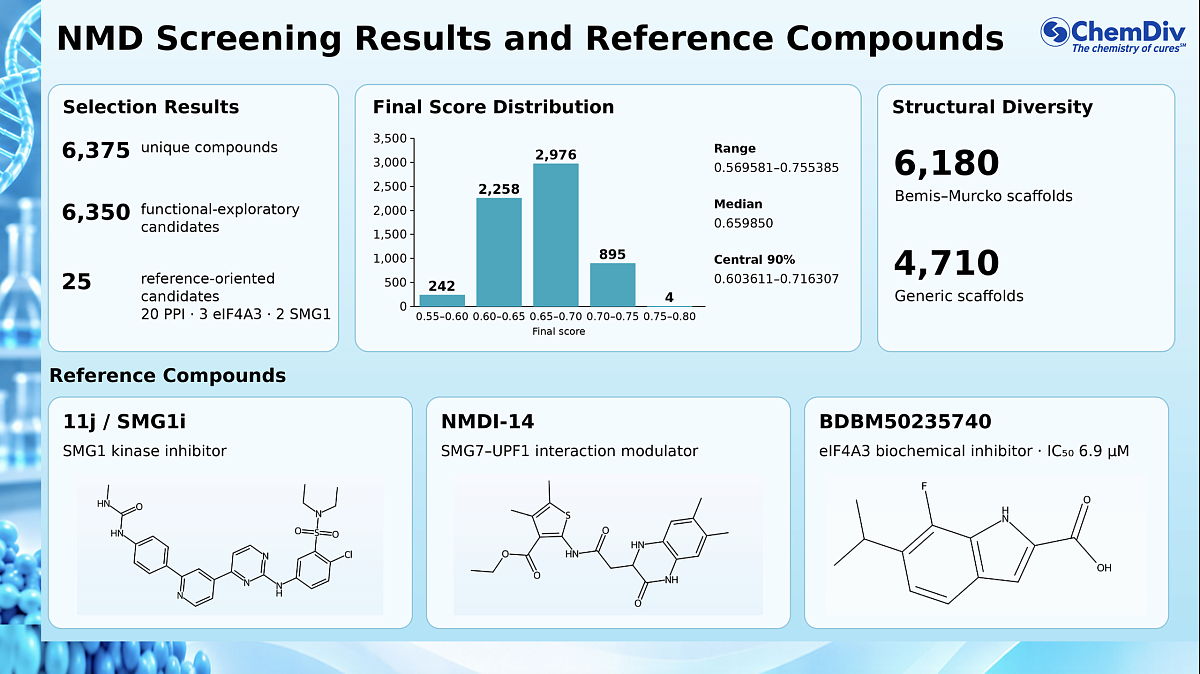
ChemDiv’s NMD Focused Library contains 6,375 unique small molecules for discovery programs studying nonsense-mediated mRNA decay (NMD). The collection combines 6,350 candidates for exploratory functional screening with 25 candidates selected around reference compounds. This design supports a broad search for compounds that alter NMD activity while providing a smaller subset for testing hypotheses about specific pathway components. The library is intended for early discovery, from primary screening and hit confirmation to follow-up studies that establish mechanism and selectivity.
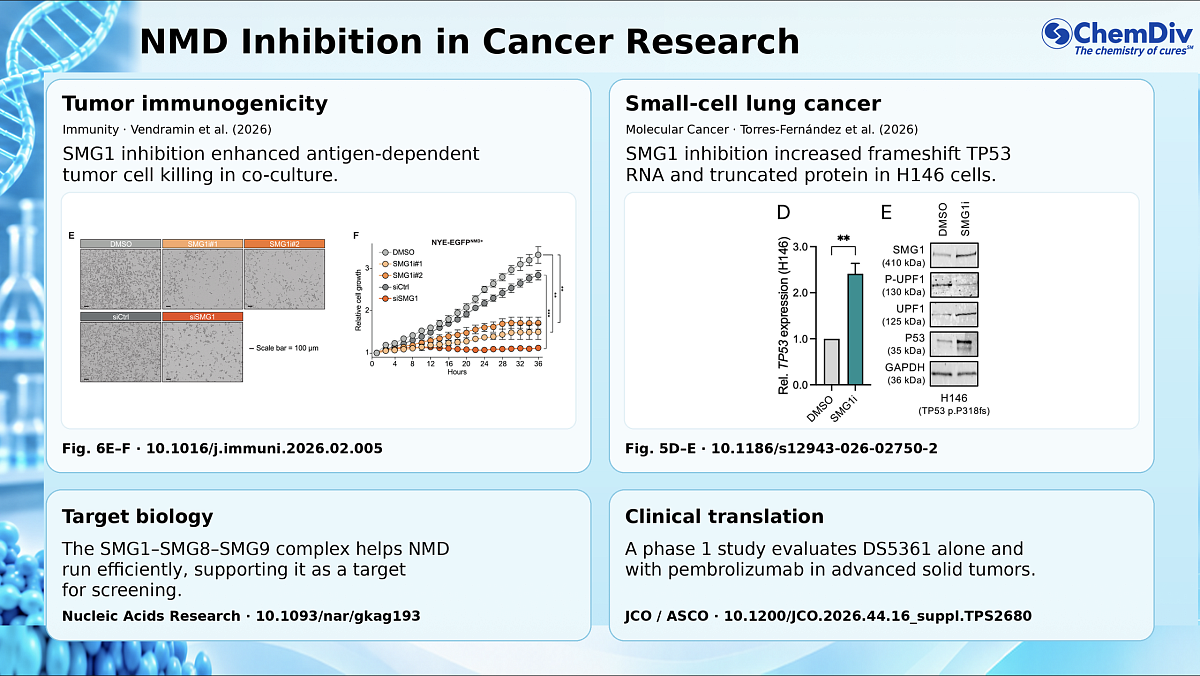
NMD is a translation-dependent RNA surveillance pathway that removes many transcripts with premature termination codons and also regulates the abundance of selected physiological transcripts. The kinase SMG1 phosphorylates UPF1, which helps initiate decay, and the SMG1–SMG8–SMG9 complex contributes to efficient pathway execution. Kueckelmann and colleagues showed that perturbing the integrity of this kinase complex affected NMD efficiency, providing a rationale for investigating how compounds influence its regulation [1]. At another point in the pathway, eIF4A3, a core component of the exon junction complex, participates in recognition of subsets of NMD substrates. Chemical inhibition of eIF4A3 disrupted UPF1 association with selected transcripts, demonstrating that an upstream recognition step can also be probed pharmacologically [2].
Tumor immunology gives this collection a specific application. Some truncating mutations produce transcripts that are normally degraded by NMD. When such transcripts persist and are translated, their products can contribute peptides to the MHC class I immunopeptidome. Cook and colleagues used the SMG1 inhibitor KVS0001 to increase the expression of selected truncation-derived products and detected increased presentation of mutant peptides in model systems [3]. Vendramin and colleagues subsequently reported that NMD inhibition reshaped the cancer immunopeptidome, promoted antigen-dependent T-cell killing in vitro and improved the activity of checkpoint inhibition in preclinical models [4]. These findings support using the library to discover chemical probes for testing whether individual tumor genotypes respond to NMD modulation with increased presentation of relevant antigens.
Small-cell lung cancer provides a second, complementary application. Torres-Fernández and colleagues found that NMD contributes to cellular homeostasis and immune control in preclinical models of this disease. Inhibiting the pathway impaired growth in experimental settings and increased the availability or presentation of selected mutation-derived products [5]. A follow-up program could evaluate NMD-sensitive transcript accumulation, tumor-cell fitness and antigen presentation as distinct endpoints. Measuring them separately would help determine whether a compound primarily affects tumor-cell survival, elicits an immune-relevant change, or produces both effects in a given model.
Alternative routes to a similar cellular phenotype also matter for hit interpretation. Barainka and colleagues showed that certain splicing modulators reduced SMG1 expression and suppressed NMD while generating aberrantly spliced transcripts [6]. An initial screening signal can therefore arise through indirect effects on RNA processing as well as direct modulation of an NMD factor. Comparing a premature-stop reporter with its matched control, confirming changes in endogenous NMD-sensitive transcripts, and monitoring viability and global translation would help distinguish those mechanisms. For compounds that remain active, the choice of follow-up readout can be guided by the hypothesis under study, such as UPF1 phosphorylation for SMG1-dependent activity or an interaction assay for SMG7–UPF1 modulation.
The collection’s main practical distinction is the pairing of broad scaffold coverage with a compact reference-oriented subset. The exploratory series gives teams a starting point for finding chemotypes beyond close analogues of established probes. The 25 reference-oriented candidates comprise 20 selected around a protein–protein interaction reference, three around an eIF4A3 reference, and two around a SMG1 reference. Their grouping reflects the criteria used to select them. Assignment of molecular targets and direction of modulation requires experimental follow-up. The three reference anchors were 11j (SMG1i), NMDI-14 (a reported modulator of the SMG7–UPF1 interaction) and BDBM50235740 (an eIF4A3 biochemical comparator).
For immuno-oncology projects, confirmed pathway modulators can be advanced to antigen-presentation or tumor–immune co-culture studies. The most informative comparisons are between matched contexts that differ in their relevant mutation, dependence on NMD, or antigen-presentation capacity. For chemical biology teams, the same collection can support a comparison of candidate mechanisms across SMG1, SMG7–UPF1 and eIF4A3. This makes it possible to select tool compounds on the basis of reproducible activity in the model of interest and to assess whether different chemotypes converge on the same cellular readout.
Selection Methodology
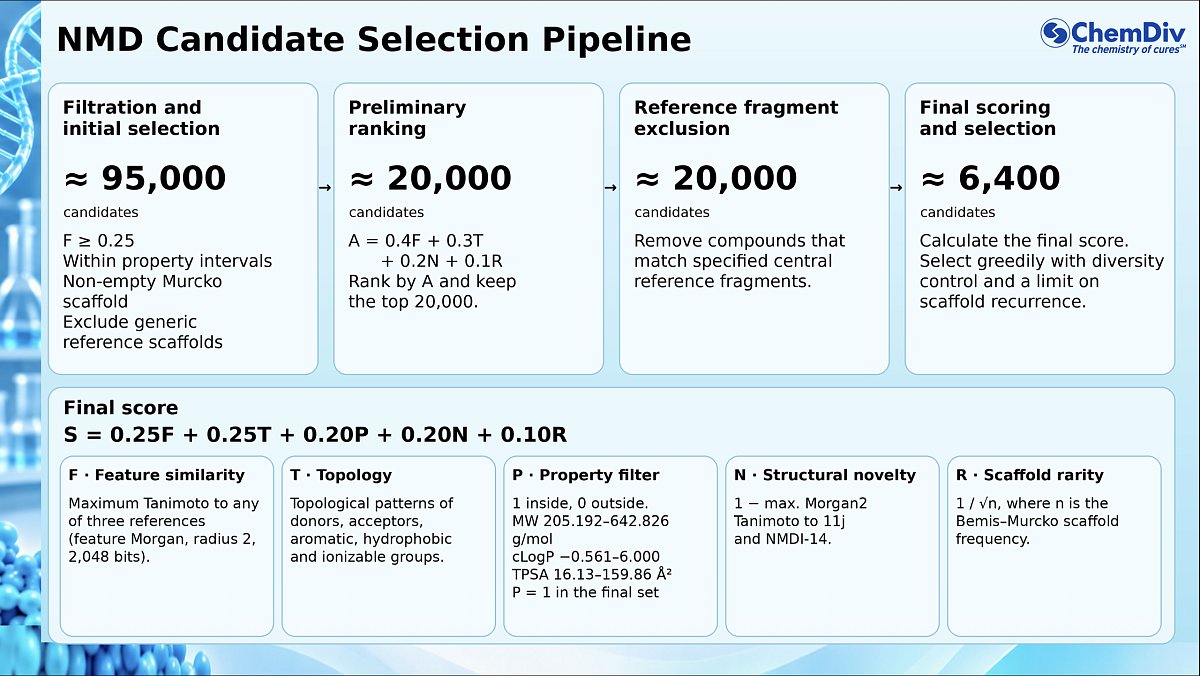
Approximately 95,000 candidates remained after initial filtration. Requirements included a feature-based similarity score of at least 0.25, a nonempty Bemis–Murcko scaffold and exclusion of generic scaffolds present in the references. The property windows were 205.192–642.826 g/mol for molecular weight, −0.561 to 6.000 for calculated logP, and 16.13–159.86 Ų for topological polar surface area. A preliminary score weighted feature similarity (F), topological correspondence (T), structural novelty (N) and scaffold rarity (R) at 0.40, 0.30, 0.20 and 0.10, respectively. The top 20,000 candidates advanced to a filter for overlap with specified central fragments of the reference compounds. The pool remained at approximately 20,000 after this step.
The final ranking used a weighted sum of F (0.25), T (0.25), compliance with the property windows P (0.20), N (0.20) and R (0.10). F was the highest Tanimoto similarity to any of the three references using radius-2, 2,048-bit feature Morgan fingerprints. T represented the similarity of topological patterns of functional groups. N was one minus the highest radius-2 Morgan fingerprint similarity to 11j or NMDI-14, and R was the inverse square root of scaffold frequency. P was binary and equaled 1 for the final set. Greedy selection incorporated a limit on repeated scaffolds to balance rank with chemical diversity.
The final collection spans 6,180 Bemis–Murcko scaffolds and 4,710 generic scaffolds. Final scores ranged from 0.569581 to 0.755385, with a median of 0.659850 and a central 90% interval of 0.603611–0.716307. The largest score interval, 0.65–0.70, contained 2,976 compounds. The score ranks candidates according to the selection criteria. Experimental potency, binding and selectivity are evaluated through the screening and confirmation assays.
References
1. Kueckelmann S, Theunissen S, Meyer Zu Altenschildesche F, et al. SMG1:SMG8:SMG9-complex integrity supports efficient execution of nonsense-mediated mRNA decay. Nucleic Acids Res. 2026, 54(5), gkag193. https://doi.org/10.1093/nar/gkag193
2. Mercier C, Durand J, Fraichard A, et al. Chemical inhibition of eIF4A3 abolishes UPF1 recruitment onto mRNA encoding NMD factors and restores their expression. Biochem Biophys Res Commun. 2025, 747, 151270. https://doi.org/10.1016/j.bbrc.2024.151270
3. Cook AL, Sur S, Dobbyn L, et al. Identification of nonsense-mediated decay inhibitors that alter the tumor immune landscape. eLife. 2025, 13, RP95952. https://doi.org/10.7554/eLife.95952
4. Vendramin R, Fu H, Fernandez Patel S, et al. Nonsense-mediated mRNA decay inhibition reshapes the cancer immunopeptidome. Immunity. 2026, 59(5), 1398–1421.e20. https://doi.org/10.1016/j.immuni.2026.02.005
5. Torres-Fernández LA, Boehm V, Kaufmann J, et al. A targetable dependency on nonsense-mediated decay for cellular homeostasis and immune control in small cell lung cancer. Mol Cancer. 2026. https://doi.org/10.1186/s12943-026-02750-2
6. Barainka M, Zheleva A, Pérez-Cervera A, et al. Pharmacological perturbation of splicing elicits SMG1 reduction: Implications for cancer therapy. iScience. 2026, 29(2), 114597. https://doi.org/10.1016/j.isci.2025.114597