





Non-CRBN E3 Molecular Glue Library
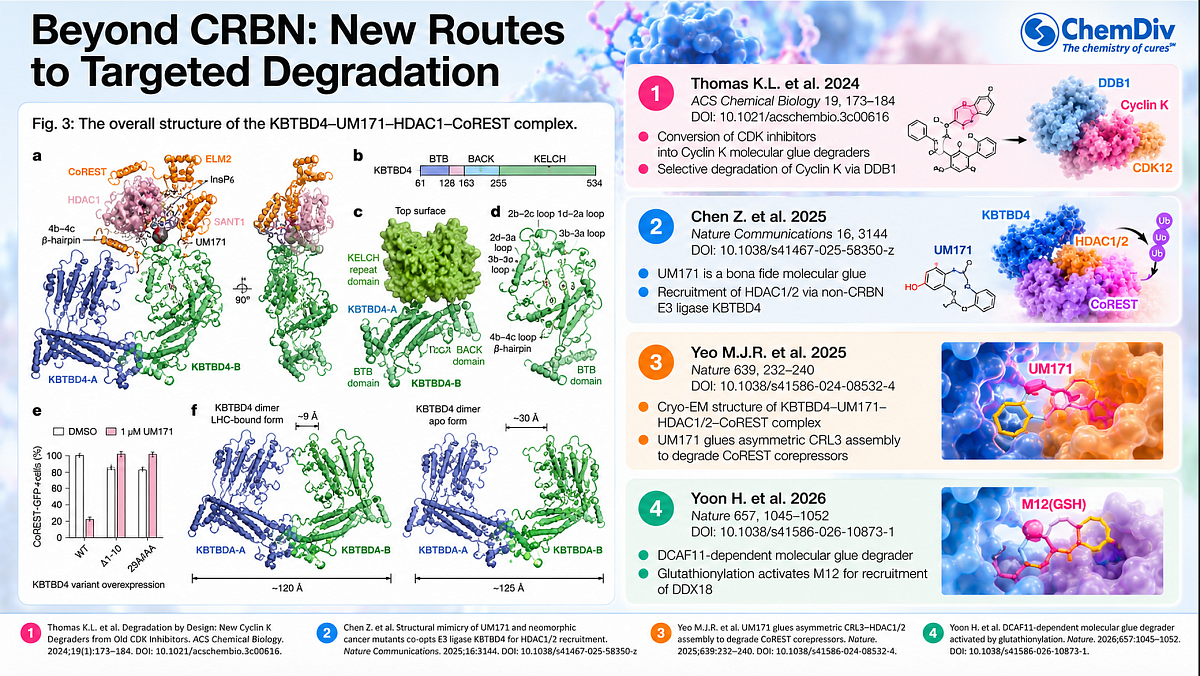
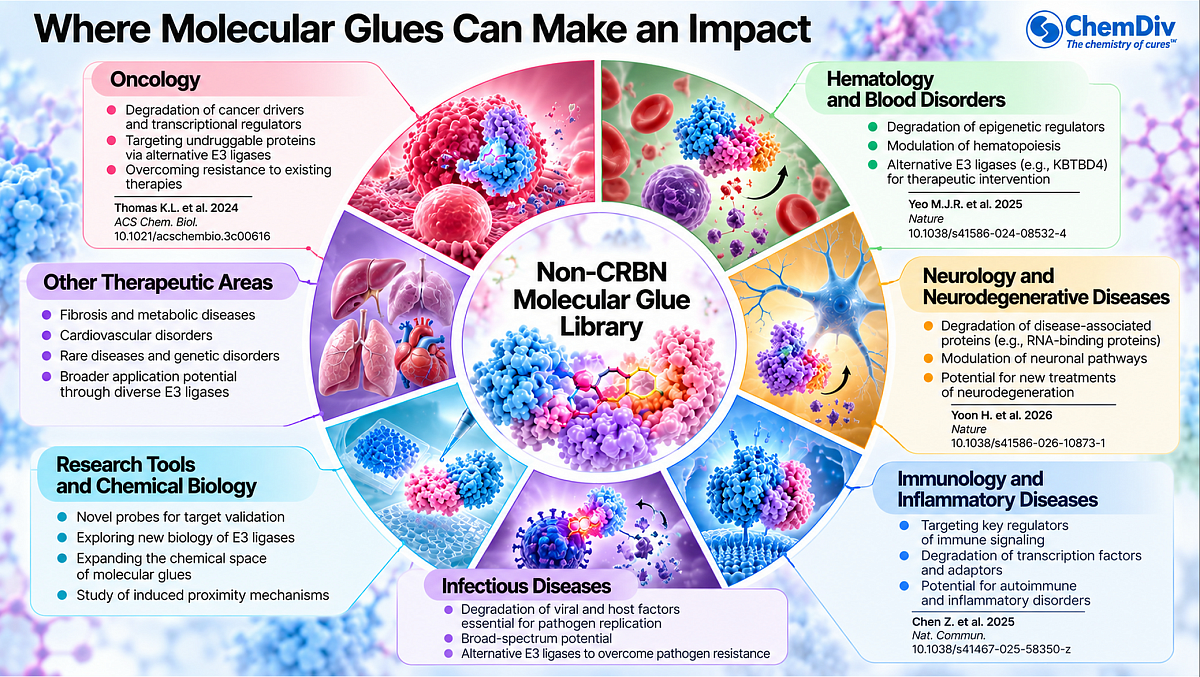
Molecular-glue degradation expands targeted protein degradation beyond bifunctional degrader architectures by using small molecules to stabilize or create productive protein–protein interactions that redirect ubiquitin-ligase machinery toward a target. The Non-CRBN E3 Molecular Glue Library was designed specifically to explore this mechanism outside the heavily used CRBN-centered chemical space. The supplied literature set illustrates that alternative E3-ligase systems can support chemically induced degradation through distinct recognition modes: DDB1-associated degradation of Cyclin K, KBTBD4-dependent recruitment of HDAC1/2 by UM171, and DCAF11-dependent degradation triggered by a glutathionylated molecular glue [1–4]. Together, these examples provide the mechanistic basis for a focused collection in which similarity to non-CRBN E3 reference chemistry is combined with molecular-glue-oriented physicochemical and structural prioritization.
The scientific value of this library lies in treating E3-ligase choice as an expandable discovery variable rather than restricting screening to one established recruiter class. The supplied studies show that molecular glues can exploit structurally and mechanistically different ligase contexts. Thomas et al. demonstrated that existing CDK-inhibitor chemistry can be converted into Cyclin K degraders acting through DDB1 [1]. Chen et al. and Yeo et al. established UM171 as a bona fide glue for KBTBD4-mediated recruitment of HDAC1/2 and structurally characterized the resulting CRL3–HDAC1/2 assembly [2,3]. The DCAF11 study further broadens this concept by showing an alternative non-CRBN E3 route in which glutathionylation activates the degrader for DDX18 recruitment [4]. These observations support a screening strategy that searches for multiple chemotypes related to experimentally grounded non-CRBN molecular-glue precedents rather than relying on a single recruiter motif.
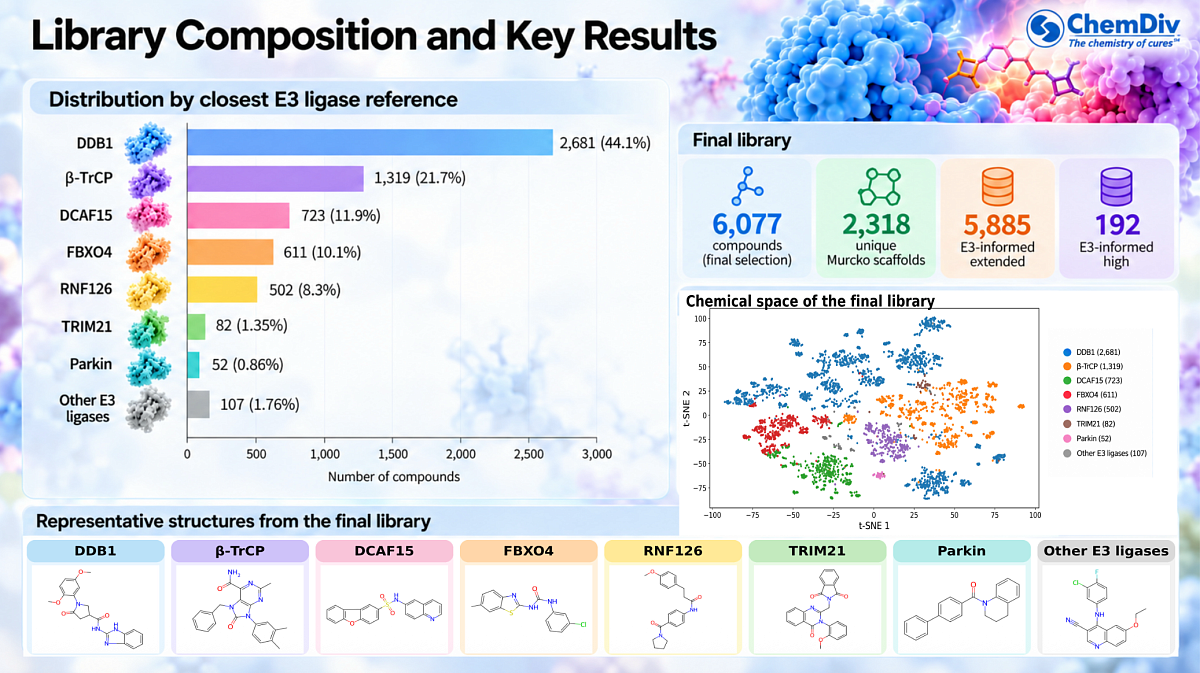
The final collection contains exactly 6,077 molecular records. It is therefore substantially more focused than the 569,633-compound source space while retaining 2,318 unique Murcko scaffold groups. This balance is important for the intended use of the library: it concentrates screening effort around compounds that satisfy the defined non-CRBN similarity and glue-like criteria, yet avoids allowing a small number of highly populated scaffolds to dominate the collection. The resulting set can complement broader screening collections by providing a chemically prioritized entry point into induced-proximity mechanisms associated with alternative E3 ligases.
The library is particularly suited to chemical-biology and targeted-degradation programs in which the objective is to discover small molecules capable of creating or stabilizing productive E3–target interactions. The supplied application material highlights oncology, hematology and blood disorders, neurology and neurodegenerative disease, immunology and inflammatory disease, infectious disease, and additional therapeutic areas as contexts in which degradation of disease-associated proteins or pathway regulators may be explored. These areas should be understood as discovery applications for the library rather than as claims of validated activity for every compound. In practical programs, the collection can be used for phenotypic or target-oriented screening followed by target deconvolution, degradation assays, proteomic profiling, and mechanistic validation of induced-proximity effects.
A second use is probe discovery. Because the collection was assembled around alternative E3-reference relationships and stringent glue-like scoring, hits can serve as starting points for studying E3-ligase biology, defining new substrate relationships, and testing whether a biological phenotype depends on protein degradation rather than conventional occupancy-driven inhibition. This is especially relevant where a target lacks a classical druggable pocket or where degradation could provide a different pharmacological phenotype from direct inhibition. The library also supports computational triage and similarity-based follow-up because every selected compound has quantitative non-CRBN E3 similarity, CRBN similarity, glue-like score, Murcko scaffold assignment, and final ranking information in the supplied selection output.
The collection is differentiated from a generic drug-like library by the conjunction of three design principles. First, compounds are required to retain measurable similarity to the non-CRBN E3 reference space. Second, they must satisfy a stringent molecular-glue-oriented score while excluding CRBN-like, PAINS, and flagged reactive structures. Third, final composition is controlled at the scaffold level. Thus, the library is not merely a set of compounds within broad molecular-property ranges; it is a deliberately enriched and diversity-balanced subset intended to test non-CRBN molecular-glue hypotheses with a manageable screening size.
Selection Methodology
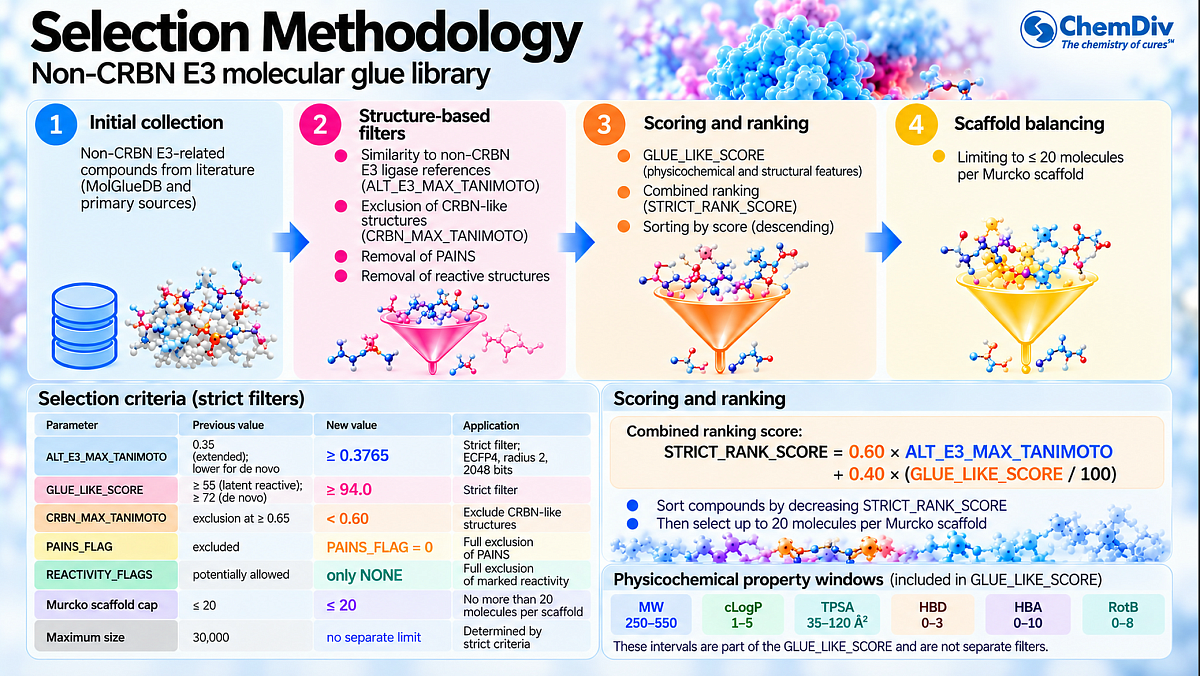
The selection began from a 569,633-compound source collection and used non-CRBN E3-related compounds from MolGlueDB and primary literature as the reference space. Structural similarity was calculated with ECFP4 fingerprints (radius 2, 2048 bits). Candidates were required to have ALT_E3_MAX_TANIMOTO ≥ 0.3765, replacing the earlier extended-set threshold of 0.35. A second hard criterion required GLUE_LIKE_SCORE ≥ 94.0, substantially tightening the previous thresholds of ≥55 for latent-reactive and ≥72 for de novo candidates. To maintain the non-CRBN focus, compounds with CRBN_MAX_TANIMOTO ≥ 0.60 were excluded; this was stricter than the previous exclusion boundary of ≥0.65. PAINS were completely removed (PAINS_FLAG = 0), and only compounds with REACTIVITY_FLAGS = NONE were retained.
The glue-like score incorporates soft physicochemical windows of MW 250–550, cLogP 1–5, TPSA 35–120 Ų, HBD 0–3, HBA 0–10, and RotB 0–8; these intervals contribute to GLUE_LIKE_SCORE and were not applied as separate hard filters. Compounds passing the strict criteria were ranked using STRICT_RANK_SCORE = 0.60 × ALT_E3_MAX_TANIMOTO + 0.40 × (GLUE_LIKE_SCORE / 100). The 7,682 compounds that passed the strict filters were sorted by decreasing rank score, after which no more than 20 molecules were retained per Murcko scaffold. Scaffold balancing reduced the set to the final 6,077 compounds distributed across 2,318 unique Murcko scaffold groups.
References
1. Thomas K. L. et al. Degradation by Design: New Cyclin K Degraders from Old CDK Inhibitors. ACS Chemical Biology. 2024;19(1):173–184. DOI: 10.1021/acschembio.3c00616. ACS Publications
2. Chen Z. et al. Structural mimicry of UM171 and neomorphic cancer mutants co-opts E3 ligase KBTBD4 for HDAC1/2 recruitment. Nature Communications. 2025;16:3144. DOI: 10.1038/s41467-025-58350-z.
3. Yeo M. J. R. et al. UM171 glues asymmetric CRL3–HDAC1/2 assembly to degrade CoREST corepressors. Nature. 2025;639:232–240. DOI: 10.1038/s41586-024-08532-4. Nature
4. Yoon H. et al. DCAF11-dependent molecular glue degrader activated by glutathionylation. Nature. 2026;657:1045–1052. DOI: 10.1038/s41586-026-10873-1. Nature
5. King E. A., Meyers M., Nomura D. K. Induced proximity-based therapeutic modalities. Nature Reviews Drug Discovery. 2026;25:175–203. DOI: 10.1038/s41573-025-01316-z.
6. Gray J. L., Xiao Z., Tate E. W. Broadening the molecular glue landscape. Nature Chemical Biology. 2026;22:1368–1370. DOI: 10.1038/s41589-026-02167-4.
7. Zhuang Z. et al. Charged molecular glue discovery enabled by targeted degron display. Nature Chemical Biology. 2026;22:1446–1455. DOI: 10.1038/s41589-026-02182-5.
8. Wang B., Zheng N. Degrons and degradation signals beyond short linear motifs. Nature Chemical Biology. 2026;22:355–368. DOI: 10.1038/s41589-025-02056-2.
9. Routes to molecular glue degrader discovery. Trends in Biochemical Sciences. 2025;50(2):134–142. DOI: 10.1016/j.tibs.2024.12.006.