





Pharmacological Chaperone Library



The Pharmacological Chaperone Library is a curated collection of 10,000 small molecules designed to identify chemically tractable, structurally diverse starting points for pharmacological chaperone (PC) discovery. Unlike traditional chemical chaperones (which act non-specifically at high concentrations), this library is optimized for high-affinity, target-specific interactions at sub-inhibitory physiological concentrations.
Scoring and Selection Algorithm
The final compound selection utilized a dedicated scoring formula prioritizing key structural features that facilitate protein binding:
PCscore = 0.7 · Sprops + 0.23 · Sref + BN + BAr
- BN (+0.04): Applied if the molecule contains at least one basic nitrogen atom (frequently involved in key electrostatic/hydrogen-bonding interactions within protein pockets).
- BAr (+0.03): Applied if the molecule contains at least one aromatic ring (to promote π-stacking and hydrophobic interactions).
Scaffold Diversity
The library exhibits high structural novelty, featuring 5,702 unique Bemis–Murcko scaffolds. To prevent over-representation of specific chemical classes, the maximum number of molecules per scaffold is strictly capped at 5:
- 1 molecule per scaffold: 3,701 scaffolds
- 2 molecules per scaffold: 920 scaffolds
- 3 molecules per scaffold: 381 scaffolds
- 4 molecules per scaffold: 184 scaffolds
- 5 molecules per scaffold: 516 scaffolds
Biological Applicability
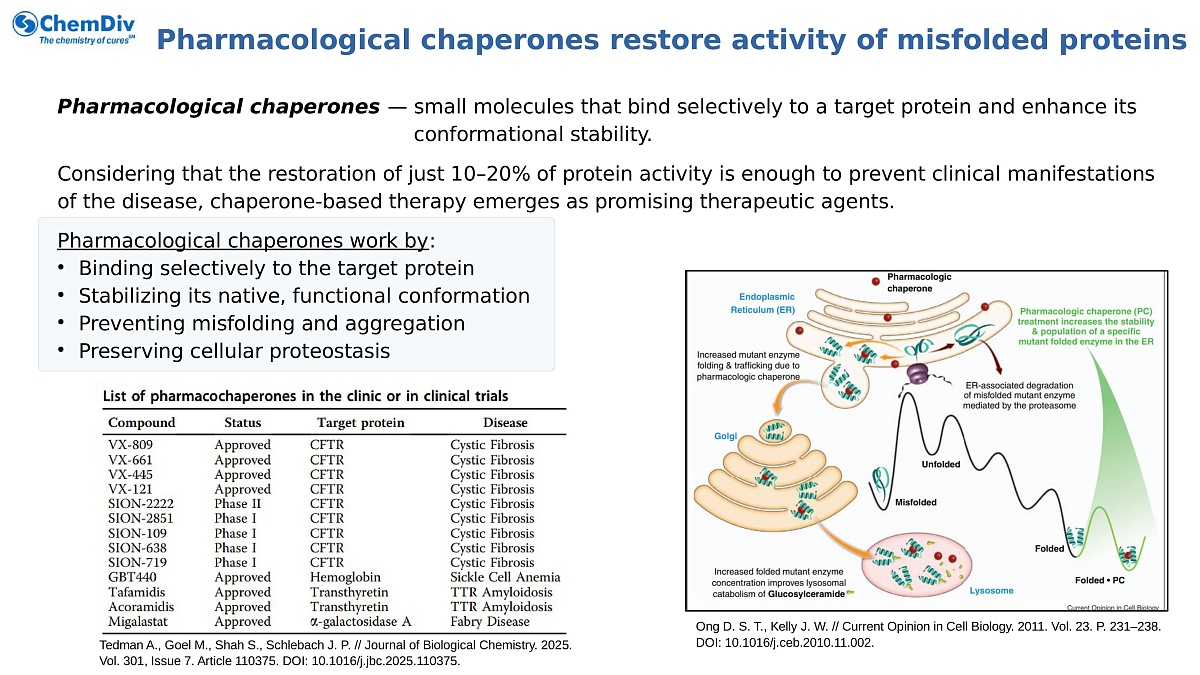
Protein misfolding is a primary driver in approximately 40% of human diseases. Missense mutations often produce proteins that remain intrinsically active but are thermodynamically unstable (ΔΔG < 5 kcal/mol). The endoplasmic reticulum-associated degradation (ERAD) pathway recognizes these unstable intermediates and degrades them prematurely before they can reach their functional destinations.
This virtual library is strategically designed to address these challenges through several key biological applications:
Targeting Allosteric and Second-Generation PC Discovery
First-generation PCs are typically competitive inhibitors (often mimicking carbohydrate structures for lysosomal enzymes). While effective at stabilizing proteins in the ER, they pose a risk of self-inhibition at the active site, requiring complex pulse-dosing regimens. This library is designed to facilitate the discovery of allosteric (second-generation) chaperones that:
- Bind outside the active site.
- Do not compete with endogenous substrates.
- Allow continuous dosing regimens due to a low risk of direct enzyme inhibition.
- Offer potential as "universal" stabilizers across multiple distinct mutant variants.
Wild-Type (WT) Screening Compatibility
Because many pathogenic variants share a similar overall native-state architecture with the wild-type protein, screening this library against stable WT proteins serves as an efficient surrogate model. Compounds that bind and stabilize the WT native conformation can often successfully rescue multiple destabilized mutants by lowering the free energy of the folded state.
Primary Therapeutic Areas of Focus
The structural profiles within the library target the main protein classes associated with conformational diseases:
- Lysosomal Storage Disorders (LSDs) [~51% of PC target space]: Including Gaucher disease (targeting β-glucocerebrosidase/GCase), Fabry disease (targeting α-galactosidase A), and Pompe disease. GCase is utilized as a core benchmark target due to its dual relevance in Gaucher disease and as a major genetic risk factor for Parkinson’s disease.
- Neurodegenerative Diseases [~48% of the PC market]: Targeting protein aggregation and misfolding pathways in Parkinson's, Alzheimer's, and Amyloidosis (e.g., Transthyretin-related hereditary amyloidosis using stabilizers like Tafamidis analogs).
- Transporters, Channels, and Receptors [~37% of target space]: Including the cystic fibrosis transmembrane conductance regulator (CFTR) for Cystic Fibrosis, and G-protein coupled receptors like the vasopressin V2 receptor (V2R) for Nephrogenic Diabetes Insipidus.
Assay Compatibility
The physical properties of these compounds make them highly compatible with standard biophysical and biological screening cascades, including:
- Differential Scanning Fluorimetry (DSF): To identify compounds that shift the thermal melting transition (ΔTm > 0).
- Surface Plasmon Resonance (SPR) / Isothermal Titration Calorimetry (ITC): For orthogonal binding and Kd determination.
- Cell-Based/Phenotypic Assays: Evaluating target protein trafficking, expression recovery, and functional enzymatic/receptor rescue in cell models.
Physicochemical and Drug-Likeness Criteria
To ensure high quality, favorable ADME properties, and synthetic tractability, the 10,000 compounds were filtered using stringent drug-likeness parameters:
- Molecular Weight (MW): 180–500 Da (optimized for fragment and lead-like properties)
- Lipophilicity (cLogP): -0.5 to 5.0
- Topological Polar Surface Area (TPSA): 20–115 Ų
- Hydrogen Bond Donors (HBD) / Acceptors (HBA): ≤ 4 / ≤ 9
- Rotatable Bonds (RotB): ≤ 9 (promoting conformational rigidity)
- Ring Count: 1–5
- Heavy Atoms: 12–38
- Fraction of sp3 Carbons (Fsp3): ≥ 0.15
- Quantitative Estimate of Drug-likeness (QED): ≥ 0.25
- Halogen Count: ≤ 4