



Aclaris Therapeutics’ Novel ITK/JAK3 Inhibitor ATI-2138 Demonstrates Rapid and Sustained Hair Regrowth in Validated Murine Model of Alopecia Areata
- Timepoint ATI-2138 vs Ritlecitinib
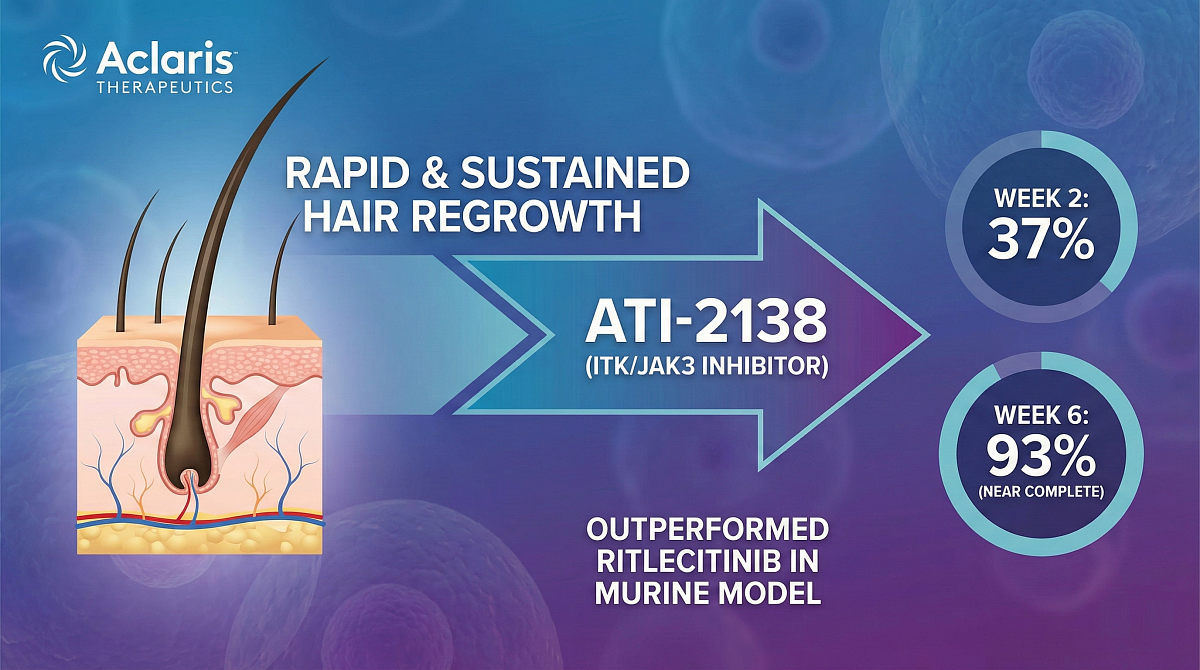
- Week 2 (Rapid): 37% vs 25%
- Week 4 (Peak): 87% vs 48%
- Week 6 (End): 93% vs 78%
- *Dose: 300 ppm for both agents
Aclaris Therapeutics, Inc., a clinical-stage biopharmaceutical company focused on developing novel product candidates for immuno-inflammatory diseases, today announced recent positive preclinical results from its potent and selective ITK/JAK3 inhibitor ATI-2138 (Modzatinib) in a murine model of severe alopecia areata (AA).
In this model of hair loss, conducted by Dr. Angela Christiano at Columbia University, ATI-2138 demonstrated rapid, near complete, and sustained hair regrowth compared to control and ritlecitinib.
Mechanism: Dual Pharmacology (ITK and JAK3)
ATI-2138 is an investigational oral compound that interrupts T cell receptor (TCR) signaling by inhibiting ITK and JAK3 signaling of IL-2 receptor common gamma chain (IL-2Rγc) cytokines in lymphocytes (including IL-2, IL-4, and IL-15). This regulates T cell expansion, differentiation and activation upstream (ITK) and downstream (JAK3).
It is highly potent for both ITK and JAK3, and more than 1,000-fold selective against other JAK isoforms. This unique pharmacology may provide a highly potent and complete anti-inflammatory response. ATI-2138 has the potential to treat a variety of inflammatory, atopic, and autoimmune diseases, including alopecias.
— Dr. Roland Kolbeck, Chief Scientific Officer of Aclaris
Preclinical Study Results: Comparison to Ritlecitinib
ATI-2138 and ritlecitinib were assessed using a reversal model of murine alopecia universalis, the most severe AA phenotype. Mice were randomized to control or drug formulated in chow (100 or 300 ppm ATI-2138; 300 ppm ritlecitinib) after hair loss was established.
The mice used in this model were significantly older and more difficult to treat than those typically studied. Despite that, ATI-2138 induced an accelerated response.
- Week 2: Rapid onset of hair regrowth was observed in mice receiving 300 ppm ATI-2138 (mean percent hair regrowth of 37%) compared to 300 ppm ritlecitinib (25%).
- Week 4: ATI-2138 reached near peak effect (87%) compared to ritlecitinib (48%).
- Week 6: The mean percent hair regrowth was 93% for ATI-2138 (300 ppm) compared to 78% for ritlecitinib (300 ppm).
Mice receiving control chow showed no improvement in hair regrowth.
— Dr. Roland Kolbeck