




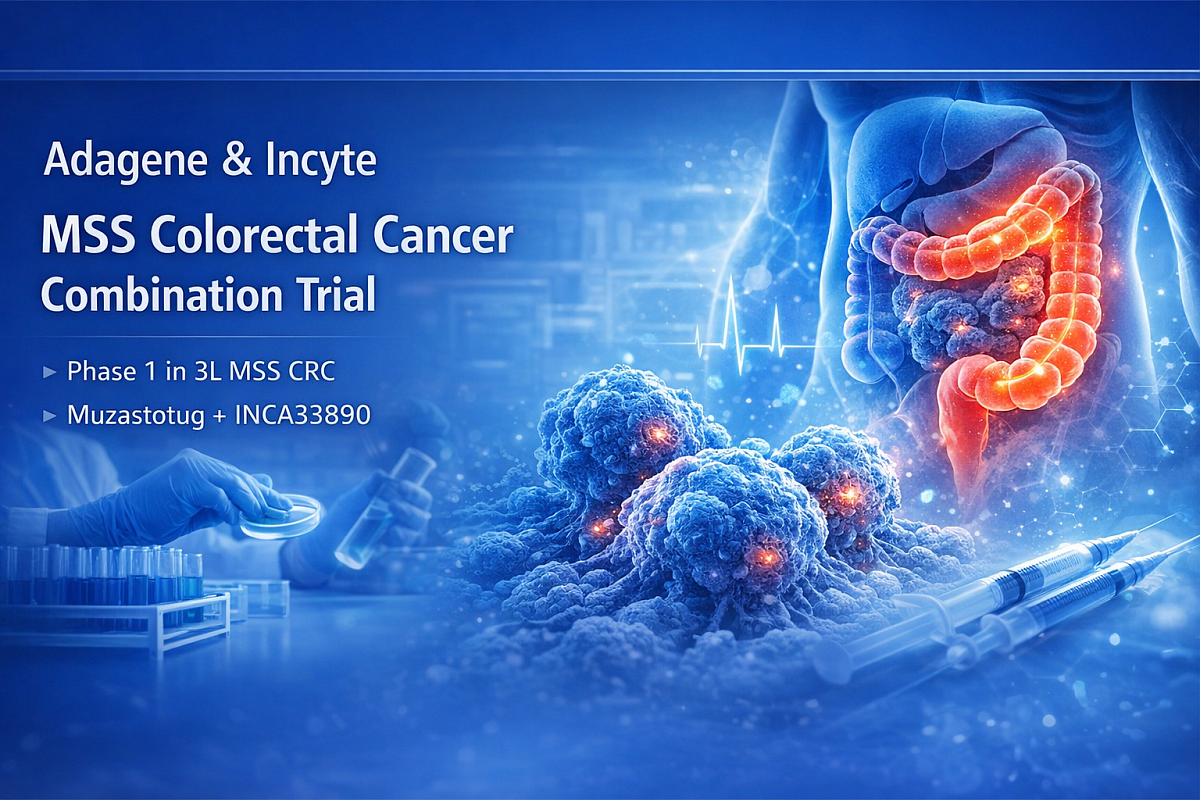
Adagene, Incyte Collaborate on Colorectal Cancer Drug Trial
Adagene and Incyte will launch a Phase 1 study in 2026 evaluating muzastotug plus INCA33890 in third-line microsatellite-stable colorectal cancer, including patients with and without liver metastases.
Adagene and Incyte are moving into a Phase 1 combination study in MSS colorectal cancer, testing a masked anti-CTLA-4 antibody with a TGFβR2 × PD-1 bispecific.
Date: April 6, 2026
Key facts
- Adagene and Incyte plan to start a Phase 1 trial in 2026 in third-line MSS colorectal cancer.
- The study will test muzastotug, a masked anti-CTLA-4 antibody, in combination with INCA33890, a TGFβR2 × PD-1 bispecific.
- The trial will enroll patients with and without liver metastases.
- The study will begin with a dose-escalation safety run-in before moving to an efficacy expansion in chemotherapy-refractory patients.
Adagene and Incyte will launch a Phase 1 study in 2026 testing the combination of Muzastotug, a masked anti-CTLA-4 antibody, with INCA33890, a TGFβR2 × PD-1 bispecific, in third-line MSS colorectal cancer patients both with and without liver metastases. Incyte will sponsor and run the trial, while Adagene will supply muzastotug. The study will follow a dose-escalation safety run-in before moving to an efficacy expansion in chemotherapy-refractory patients.
In parallel, Incyte has already advanced INCA33890 upstream into first line through a 700-patient Phase 3 study adding the agent to bevacizumab plus FOLFOX in MSS colorectal cancer, underscoring a broader franchise-level push around the bispecific. That means the newly announced Phase 1 collaboration is not an isolated experiment, but part of a wider strategic effort to build treatment optionality around one of the toughest immuno-oncology indications.
Strategic significance for Adagene and Incyte in MSS colorectal cancer
Strategically, this is an expansion play for both companies built around tackling one of the hardest immuno-oncology settings. For Incyte, layering a CTLA-4 mechanism onto its PD-1 × TGFβR2 backbone broadens optionality if the bispecific alone does not convert immunologically cold tumors. It also creates read-across between third-line biology and the ongoing first-line registrational program, potentially sharpening patient selection hypotheses around TGFβ signaling, immune exclusion, and the particularly resistant liver metastasis subset.
For Adagene, having the larger partner sponsor the study reduces cash burden and operational risk while positioning muzastotug as a plug-in backbone for PD-1-based bispecifics. The SAFEbody masking approach is central to that pitch. If the masking strategy meaningfully widens the therapeutic index for CTLA-4, the company can more credibly pursue greater immunomodulatory intensity without prohibitive toxicity, which has historically limited the broader use of CTLA-4 combinations.
The collaboration is aimed at one of the most resistant immuno-oncology settings, where translational insight, liver metastasis biology and tolerability may determine whether the combination can create meaningful differentiation.
Operational complexity will be high for sites, CROs and biomarker vendors
For sites and contract research organizations, the operational profile will be complex. Managing overlapping immune-related toxicities from CTLA-4 and PD-1, alongside uncertainties tied to TGFβ pathway modulation, will require tight safety monitoring, hepatic function vigilance, and clear steroid-sparing algorithms. This may be especially critical in patients with liver metastases, where immune hepatitis risk and baseline liver dysfunction can complicate attribution and response evaluation.
Enrollment may benefit from the large pool of refractory MSS colorectal cancer patients, but competition for this population remains high. In addition, the trial’s stratification by liver metastasis status and its expected emphasis on serial biopsies and translational sampling could raise operational burden for participating sites. Vendors with robust pharmacodynamic and biomarker capabilities around TGFβ signatures, regulatory T-cell depletion and intratumoral immune remodeling are likely to be prioritized as the program advances.
Regulators will likely look for clean dose-escalation data, evidence of manageable hepatic safety, and consistent signals within the liver metastasis subgroup. That is particularly important because liver metastases have historically represented one of the most resistant phenotypes in colorectal cancer checkpoint therapy and often serve as a major barrier to broader immunotherapy success in MSS disease.
Key watch points are timing, tolerability and translational clarity
The key watch items are timing, tolerability and translational clarity. A 2026 study start pushes any decision-enabling readout toward the later part of the decade, increasing execution risk and creating potential overlap with readouts from Incyte’s first-line Phase 3 program. Early dose-escalation data will need to show that the combination can achieve biologically relevant exposure without CTLA-4-driven toxicity undermining feasibility.
Any early response or durable disease control in the liver metastasis cohort would be strategically differentiating. On the other hand, the history of the field sets a high bar. Previous disappointment with TGFβ-targeted combinations, as well as limited gains from PD-1 and CTLA-4 combinations in MSS colorectal cancer, means the sponsors will need more than a modest efficacy signal to change expectations around this setting.
Expect the companies to rely heavily on biomarker-defined narratives to guide next steps, including whether to move into a randomized expansion against physician’s choice. If the signal proves credible and tolerability holds, the development path could eventually converge with Incyte’s broader registrational strategy. If not, the collaboration may remain best understood as a targeted option-value exercise rather than a true turning point for the MSS colorectal cancer treatment landscape.