



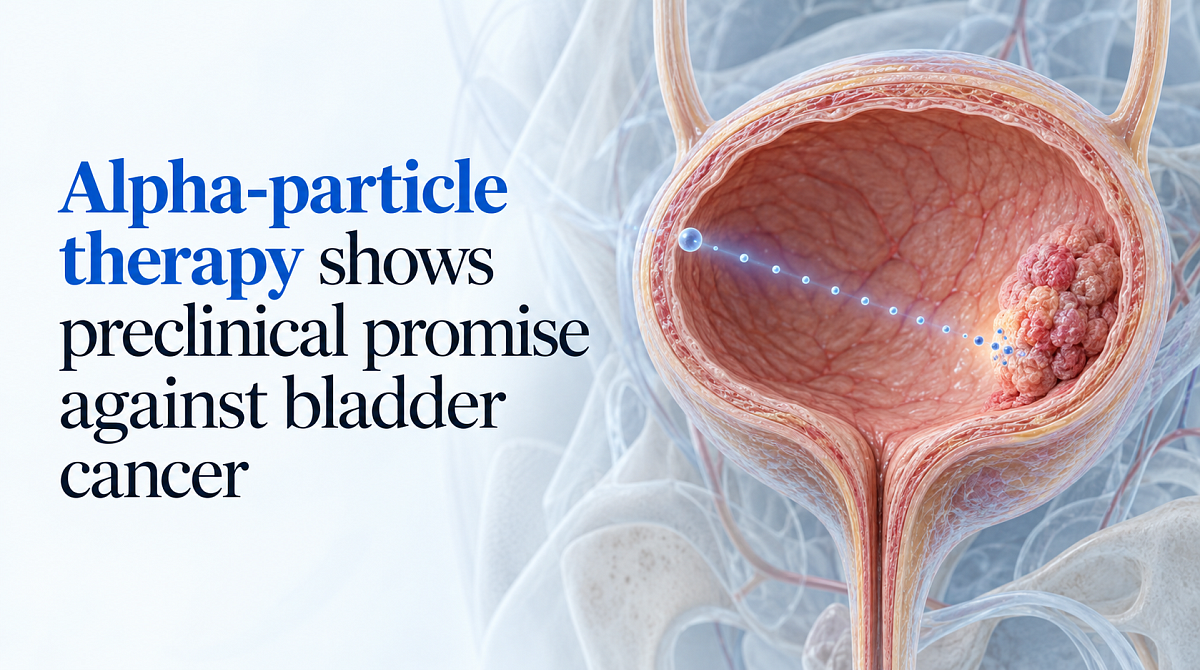
Alpha-particle therapy shows preclinical promise against bladder cancer cells
Click to view quick news summary (Spoiler)
Bismuth-213-labeled trastuzumab and cetuximab show dose-dependent cytotoxicity in bladder cancer cell lines, supporting further investigation.
Bladder cancer remains a major global health burden, and non-muscle-invasive bladder cancer accounts for the majority of cases. When standard-of-care therapy with BCG fails, which happens in up to 30–40% of patients, treatment options are limited, highlighting the need for alternative bladder-sparing approaches. A new preclinical study, published in EJNMMI Research, explored one such approach: targeted alpha-particle therapy using bismuth-213-labeled antibodies directed against two receptor targets, EGFR and HER2.
The research team characterized EGFR and HER2 expression in human bladder cancer cell lines and then evaluated a combination treatment consisting of [213Bi]Bi-labeled trastuzumab plus cetuximab.
Receptor profiling revealed that both antibodies exhibited specific, high-affinity binding to all human bladder cancer cells tested.
Functionally, the treatment produced dose-dependent cytotoxicity in SCaBER and RT4 cells. The treated cells also showed increased DNA-damage markers, which were associated with increased cell-death markers, suggesting that the alpha-particle radiation was killing the cells through accumulated DNA damage.
Transcriptional analysis added mechanistic depth. The 213Bi treatments induced dose-dependent transcriptional changes by inducing irreparable DNA damage, disrupting DNA repair pathways, and activating multiple regulated cell death mechanisms. In other words, the therapy appears to overwhelm the cells’ capacity to repair radiation-induced breaks, triggering several cell death programs at once.
Immunoblot analysis provided a more nuanced picture of the cellular response. Chk1 and Wee1, proteins involved in DNA damage checkpoint control, showed expression and activation comparable between [213Bi]Bi-trastuzumab+cetuximab-treated cells and untreated controls after 48 hours of treatment with 0.3 MBq of 213Bi.
The authors conclude that targeted alpha therapy using combined 213Bi-labeled trastuzumab plus cetuximab demonstrated strong preclinical efficacy in human bladder cancer cell lines, supporting its potential for further clinical development. It is important to emphasize that these findings come from in vitro cell line experiments; no patient data are reported in this study, and efficacy in humans remains to be established through clinical trials.
Nevertheless, the study addresses a genuine clinical gap. By combining receptor profiling with functional testing of a dual-targeted alpha emitter, the work provides a preclinical foundation for evaluating whether this strategy can eventually be translated to patients whose tumors express EGFR or HER2.