



Annovis Bio has partnered with NeuroRPM to implement a new US FDA-cleared AI platform.
The biotech company is developing an investigational oral therapy, buntanetap, for neurodegenerative diseases such as Alzheimer’s disease (AD) and Parkinson’s disease (PD) and will be working with NeuroRPM, a digital healthtech company.
The ANVS-25002 Open-Label Study
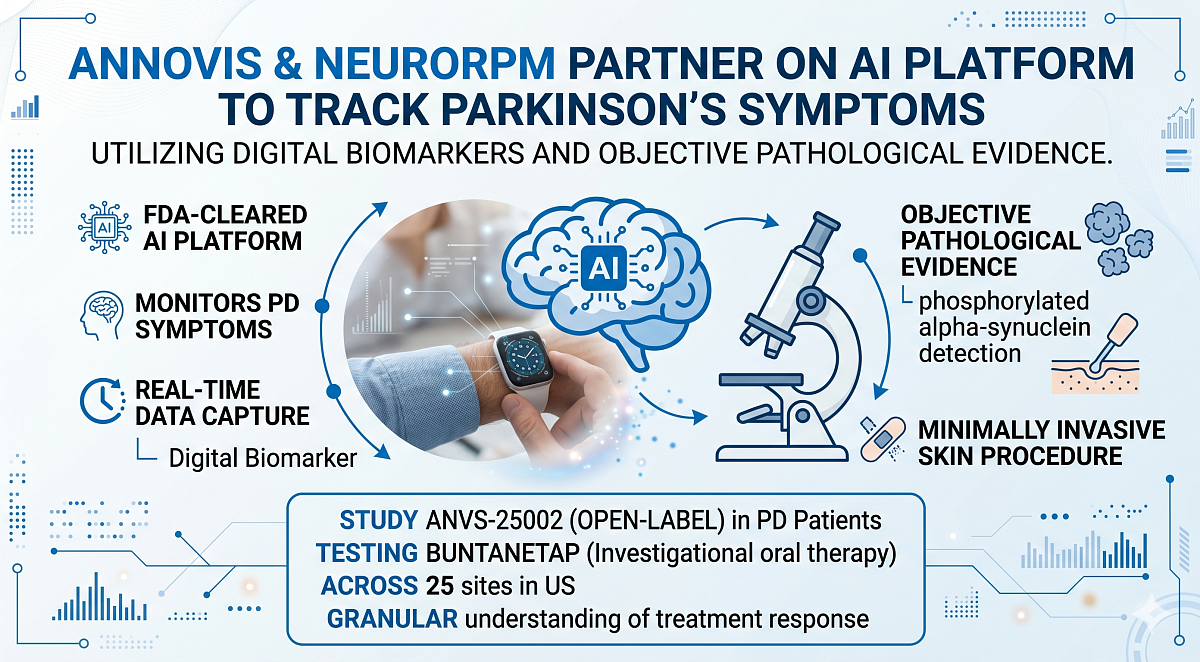
Currently, Annovis is enrolling participants for an open-label study, ANVS-25002, in PD patients. Taking place across 25 sites in the US over 36 months, the study will test buntanetap using both the new AI platform and a biomarker test.
AI-Powered Symptom Monitoring
The platform will use AI to monitor the primary PD symptoms and create a digital biomarker, capturing real-time data on how the symptoms change during the study.
By passively collecting data, the burden on patients is minimised and treatment response can be further understood in everyday life. As well as tracking symptoms, the AI platform will provide medication tracking and schedule reminder features.
“Continuous wearable monitoring enables objective measurement in real-world settings, helping researchers develop a more granular understanding of treatment response and a stronger evidence base for how a therapy is performing in daily life,” said Atila Omer, CEO of NeuroRPM.
Biomarker Testing and Objective Evidence
Annovis’ biomarker test will identify the presence of misfolded phosphorylated alpha-synuclein, a hallmark of PD pathology, using a minimally invasive skin procedure. The test has a sensitivity and specificity of over 90%, allowing it to provide objective pathological evidence of the disease.
Cheng Fang, Senior Vice President, Research and Development at Annovis, said: “We believe that data-driven insights generated from NeuroRPM’s platform will complement our existing data collection and strengthen the evidence-based monitoring of disease progression throughout the trial.
“The data generated in this open-label study, together with novel biomarkers, will produce a wealth of information and provide additional insights into our understanding of the disease trajectory and will help inform the design of future clinical trials.”