



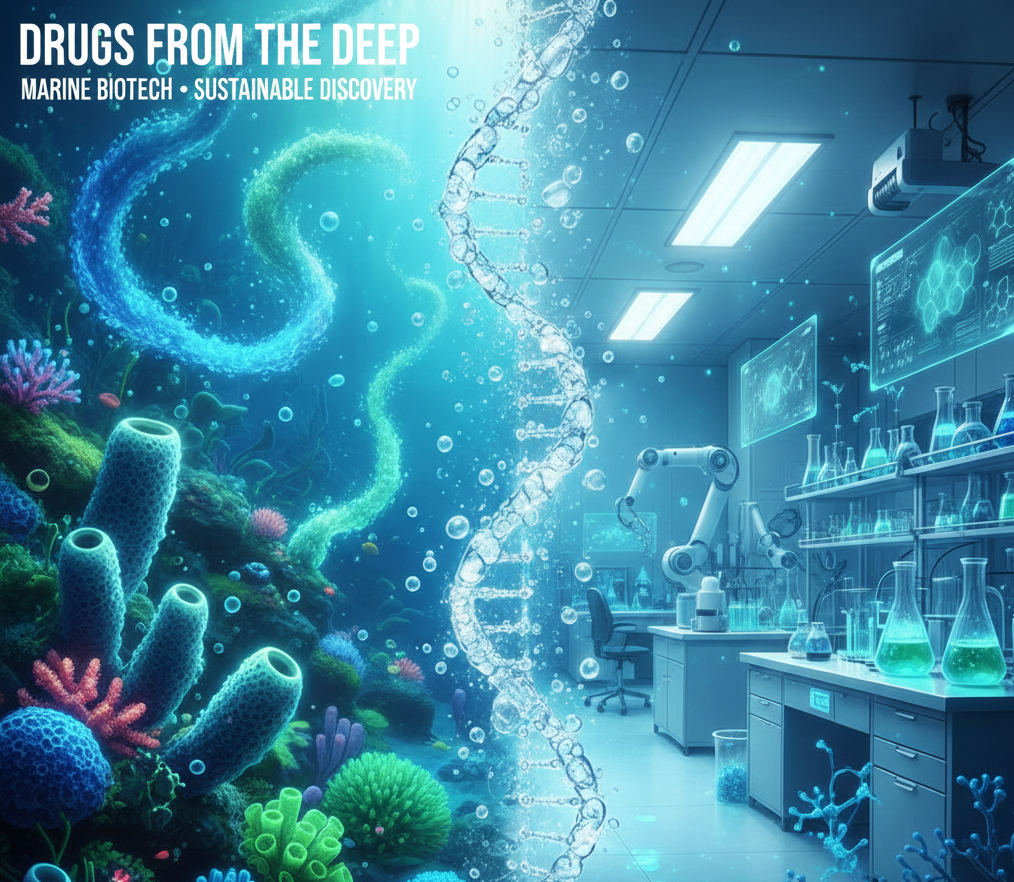
Drugs from the Deep: Balancing Pharmaceutical Potential with Ecological Sustainability
From advanced cancer treatments to cutting-edge antiviral therapies, some of the most potent medicines in modern pharmacopeia trace their origins to the ocean's depths. However, as the field of "Blue Pharmaceuticals" expands, scientists face a critical challenge: transforming rare marine molecules into scalable, usable drugs without devastating fragile aquatic ecosystems.
According to a recent review by Zubair Abdulkarim, a microbiologist at MES Ponnani College, these approved medicines are already revolutionizing the treatment of breast cancer, leukemia, lymphoma, multiple myeloma, and chronic pain. Yet, the pipeline from discovery to the pharmacy shelf remains notoriously slow, primarily due to a massive supply bottleneck.
Case Study: Eribulin (Halaven)
Eribulin, a revolutionary chemotherapy drug, was inspired by halichondrin B, found in the marine sponge Halichondria okadai. The natural scarcity was staggering: 1 ton of sponge yielded just 1 gram of the compound. This forced scientists into a four-decade-long effort to create a synthetic analogue, highlighting the extreme difficulty of transitioning from "ocean to lab".
To move beyond the limitations of natural extraction, researchers are pivoting toward scalable, technology-driven production methods that preserve the marine environment.
These biorefineries could represent a sustainable "blue bioeconomy," not only delivering life-saving treatments but potentially aiding environmental remediation. As 2026 unfolds, the focus remains on perfecting these scalable platforms to ensure the next generation of drugs from the deep doesn't cost us the health of the deep itself.
About the Researcher: Zubair Abdulkarim serves as an assistant professor at MES Ponnani College in Kerala, India, specializing in the scientific review of blue pharmaceuticals and marine natural products.