



Daraxonrasib: A New Era in Targeted Therapy for Pancreatic Cancer
Metastatic pancreatic adenocarcinoma (mPDAC) remains one of the most aggressive and deadly malignancies, with limited therapeutic options and a typically poor prognosis.The standard first-line treatment for patients with this RAS-driven disease offers limited benefit (objective response rate (ORR): 23%-43%; PFS at 6 months: 40%-50%; median overall survival (mOS): 8.5-11.7 months).However, recent advances in targeted therapy have brought renewed hope to patients and clinicians alike.
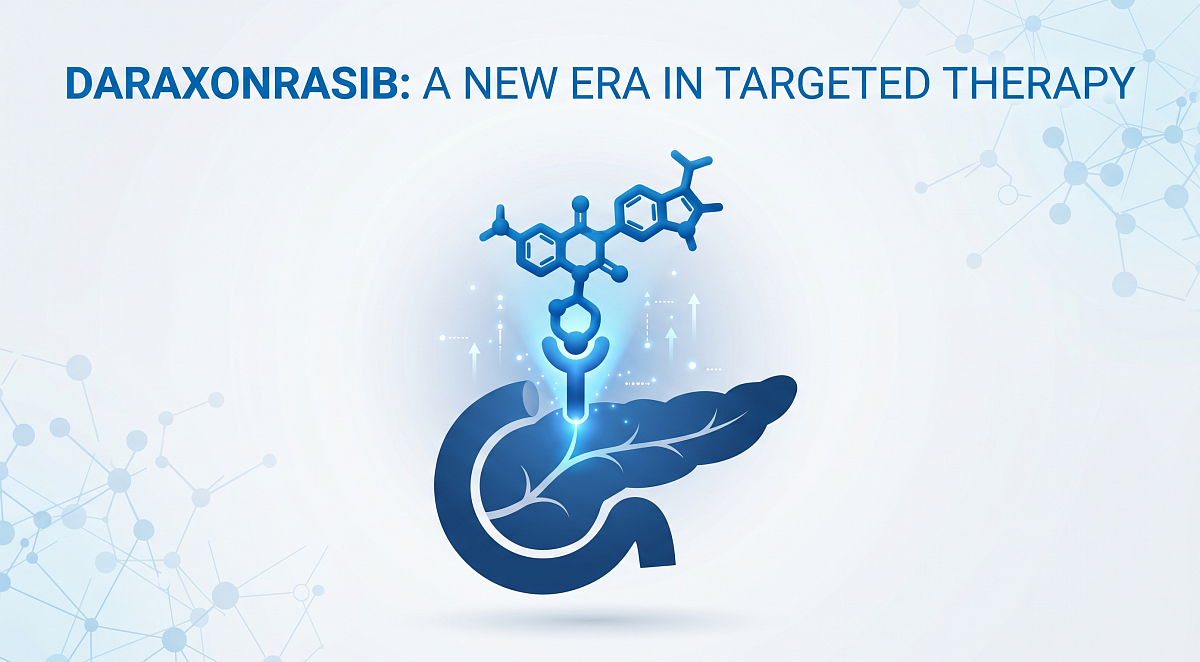
A notable breakthrough is the investigational drug daraxonrasib (formerly RMC-6236), an investigational, oral RAS(ON) multi-selective, non-covalent inhibitor, which is being developed by Revolution Medicine, and was recently authorized by the U.S. Food & Drug Administration (FDA) for expanded access, allowing more patients to be included in continued pivotal studies.
Targeting the ‘Undruggable’ KRAS Mutation
KRAS mutations drive more than 90% of pancreatic cancers, yet for decades, direct targeting of KRAS was considered impossible.Pancreatic cancer is the most RAS-addicted of all major cancers, with more than 90% of patients harboring tumors driven by mutations in RAS proteins.These mutations span a range of RAS variants that fuel aggressive tumor behavior.Daraxonrasib is the first-in-class RAS(ON) tri-complex inhibitor designed to shut down growth signals from mutated KRAS, halting cancer cell proliferation.
As Wungki Park, MD, MS, a Gastrointestinal Oncologist and Assistant Attending Physician at Memorial Sloan Kettering Cancer Center (MSK) in New York, specializing in pancreatic and biliary tract cancers, explains, “Daraxonrasib shuts down the growth signals generated by mutated KRAS, which causes pancreatic cancer cells to stop growing. For the first time, we can clinically target the dominant KRAS signals that drive most pancreatic cancers. This could be a paradigm shift in how we treat this cancer after more than three decades of relying mainly on chemotherapy.”
Clinical Trial Results
Findings from a phase 1/2 trial were presented during the annual meeting of the American Association for Cancer Research, held April 17 – 22, 2026, in San Diego, and were published in The New England Journal of Medicine in May 2026.These findings demonstrated promising outcomes for patients with advanced, previously treated pancreatic cancer.
Among 168 patients (ages 30–86, 45% female) at 16 U.S. centers, all with stage 4 disease and prior chemotherapy, who received daraxonrasib at a dose of 300 mg or less, the investigational drug achieved:
- 35% objective response rate (ORR) in the RAS G12 cohort
- Median progression-free survival (PFS) of 8.5 months
- Median overall survival (OS) of 13.1 months
For the broader cohort (RAS G12/G13/Q61 mutations), ORR was 29%, PFS 8.1 months, and OS 15.6 months.These figures compare favorably with standard second-line chemotherapy, which typically yields shorter periods of disease control.Many patients participating in the study experienced dramatic improvements in symptoms within days of starting treatment, a response rarely seen with standard chemotherapy.No patients in the trial discontinued daraxonrasib at the 300-mg daily dose due to side effects.“Many trial participants enjoy a better quality of life, in part because they don’t have as many debilitating side effects as they do with conventional chemotherapy,” Park noted.
Broad Activity Against KRAS Mutations
Daraxonrasib demonstrated efficacy across a range of KRAS mutations, including KRAS G12D, KRAS G12V, KRAS G12R, and KRAS Q61X, suggesting it may benefit a broad spectrum of patients.This breadth of activity is significant, as KRAS mutations are heterogeneous and have previously limited the utility of targeted agents.
Based on early positive data, the FDA granted daraxonrasib Breakthrough Therapy designation in June 2025 and accelerated its review under the Commissioner’s National Priority Voucher program.Phase 3 trials are now underway at MSK and globally, examining daraxonrasib in both first-line and previously treated metastatic pancreatic cancer.The primary endpoints are progression-free and overall survival compared to standard-of-care chemotherapy.The team at Memorial Sloan Kettering Cancer Center and their collaborators are also investigating next-generation KRAS inhibitors and combination strategies across multiple RAS-driven cancers.The ongoing RASolute 302 trial has further confirmed daraxonrasib’s survival benefits, showing a median OS of 13.2 months versus 6.7 months for chemotherapy—a 60% reduction in the risk of death.
Significant advancement
Daraxonrasib works by forming a tri-complex with the chaperone protein CypA and RAS, locking the KRAS ‘green light’ signal that otherwise drives uncontrolled cancer cell growth.This mechanism has enabled researchers to overcome the historic challenge of ‘undruggable’ RAS mutations.Daraxonrasib represents a significant advancement in the treatment of pancreatic ductal adenocarcinoma (PDAC), offering improved outcomes, manageable side effects, and renewed hope for patients.The FDA’s expanded access authorization and ongoing phase 3 trials highlight the drug’s potential to become a new standard of care.As research continues, daraxonrasib and other RAS-targeted therapies may transform the outlook for patients with this devastating disease and other RAS-driven cancers.