



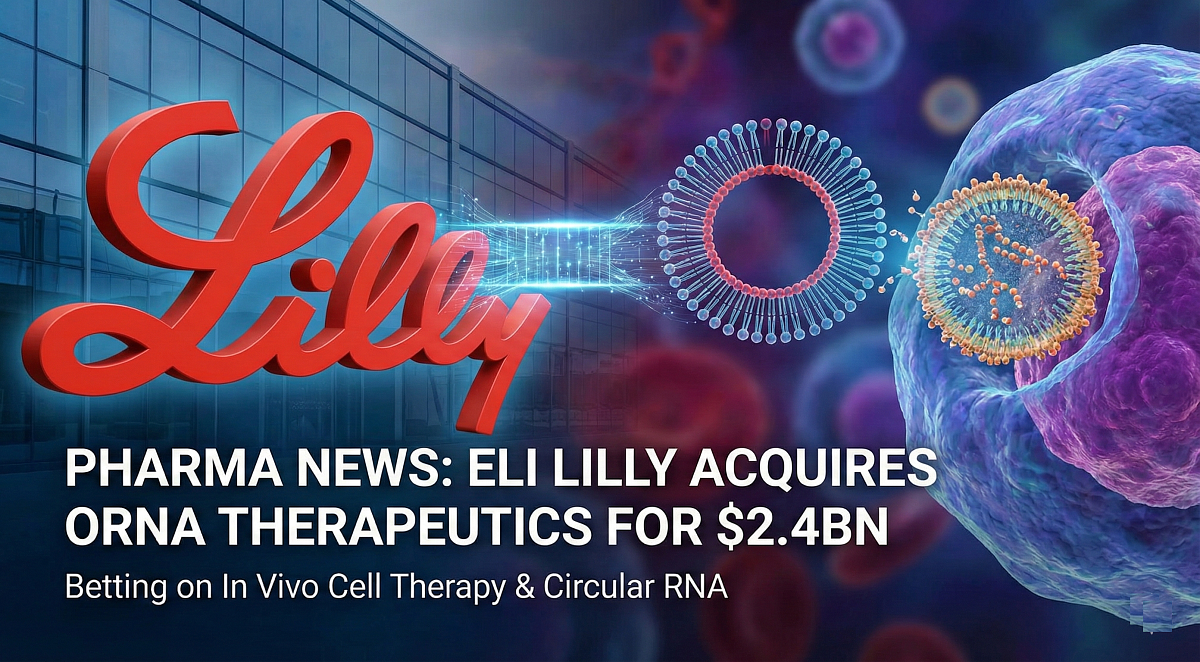
Eli Lilly joins the growing list of big pharma companies hoping to see success from their acquired in vivo CAR-T programmes. The company is acquiring in vivo cell therapy-focused biotech, Orna Therapeutics, in an immunology deal worth up to $2.4bn.
Through the agreement, Lilly will gain access to Orna’s new class of circular RNA (circRNA) and lipid nanoparticle-based therapies. These are designed to trigger the creation of therapeutic proteins by a recipient’s immune system to treat autoimmune diseases in vivo. At the heart of this deal lies ORN-252, which Orna is developing to treat B-cell-driven autoimmune diseases by targeting the CD19 lymphocyte surface antigen.
Efficacy & Differentiation: Preclinical trials on the circRNA platform have demonstrated promising efficacy signals, triggering more durable expression of therapeutic proteins than other RNA or cell therapy platforms. Orna believes this could "unlock treatments that are not feasible with current technologies."
Eli Lilly’s Orna acquisition follows a flurry of high-value deals in early 2026, including a $1.12bn agreement with Seamless Therapeutics and a $1.2bn acquisition of Ventyx. These moves bolster Lilly’s cell and gene therapy (CGT) pipeline, which saw 27 deals signed between 2020 and 2025 according to GlobalData.
This strategic expansion comes after a positive FY2025, where Lilly achieved 45% sales growth driven by its obesity portfolio. The company recently made history as the first healthcare entity to join the $1tn market cap club, alongside tech leaders like NVIDIA and Apple.
In Vivo Cell Therapies Catch Industry Attention
As companies look to mitigate commercialisation and manufacturing (CMC) challenges, many are betting on in vivo CAR-T alternatives. Unlike traditional autologous models, in vivo therapies are less complex and expensive to manufacture. They also sidestep patient-related challenges like lymphodepletion or bridging therapies.
Lilly is not alone in this pursuit. In 2025, AbbVie acquired Capstan Therapeutics for $2.1bn, Gilead’s Kite Therapeutics invested $350m in Interius BioTherapeutics, and BMS merged with Orbital Therapeutics in a $1.5bn deal, all signalling a massive industry shift toward in vivo models.