



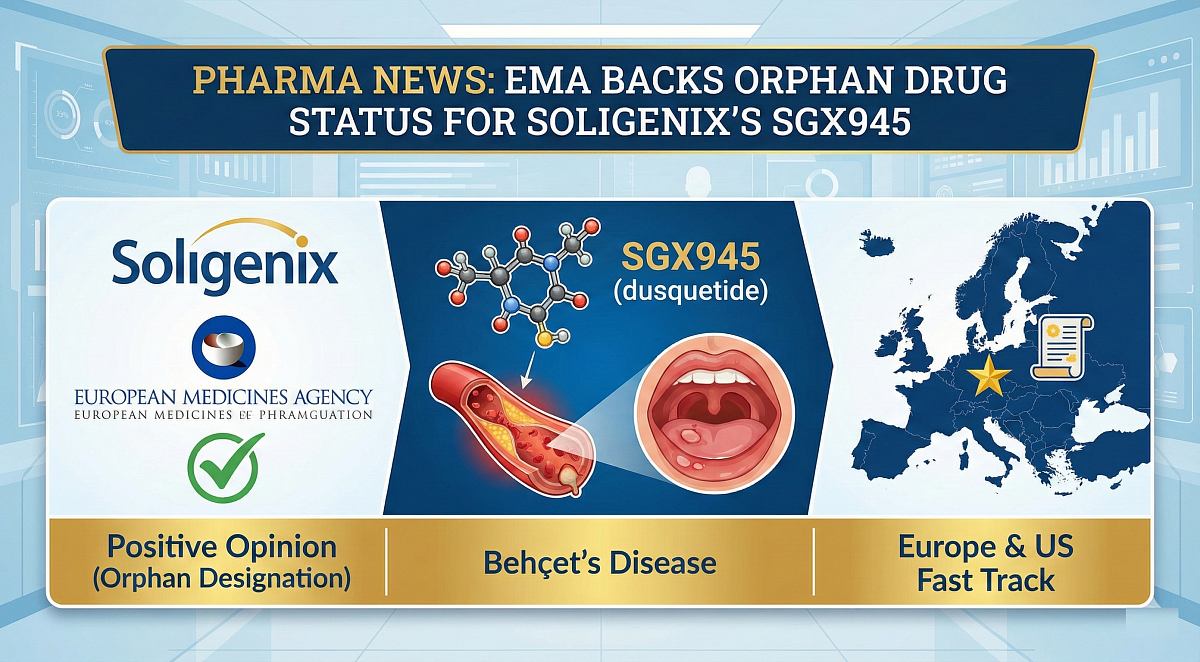
PRINCETON, N.J., Feb. 26, 2026 -- Soligenix, Inc., a late-stage biopharmaceutical company focused on developing and commercializing products to treat rare diseases where there is an unmet medical need, announced today that the European Medicines Agency (EMA) Committee for Orphan Medicinal Products (COMP) provided a positive recommendation on the Company's request for orphan drug designation for dusquetide (the active pharmaceutical ingredient in SGX945) for the treatment of Behçet's Disease, following review of the recently published Phase 2a clinical results demonstrating biological efficacy and safety in patients with Behçet's Disease.
The next step in the process will be ratification of the positive opinion by the European Commission. SGX945 has previously been granted both orphan drug and fast track designations from the US Food and Drug Administration (FDA) for the treatment of Behçet's Disease.
About Dusquetide
Dusquetide, the active ingredient in SGX945 (Behçet's Disease) and SGX942 (oral mucositis), is an innate defense regulator (IDR), a new class of short, synthetic peptides. It has a novel mechanism of action whereby it modulates the body's reaction to both injury and infection towards an anti-inflammatory, anti-infective, and tissue healing response.
IDRs have no direct antibiotic activity but, by modulating the host's innate immune system responses, increase survival after infections caused by a broad range of Gram-negative and Gram-positive bacterial pathogens. Dusquetide also accelerates resolution of tissue damage following exposure to a variety of agents including bacterial pathogens, trauma, and chemo- and/or radiation therapy. Preclinical efficacy and safety have been demonstrated in numerous animal disease models including mucositis, colitis, macrophage activation syndrome as well as bacterial infections. In addition, potential anti-tumor activity has been demonstrated in multiple in vitro and in vivo xenograft studies.
Dusquetide has demonstrated safety and tolerability in a Phase 1 clinical study in 84 healthy human volunteers. In Phase 2 and 3 clinical studies with dusquetide in over 350 subjects with oral mucositis due to chemoradiation therapy for head and neck cancer, positive efficacy results were demonstrated, including potential long-term ancillary benefits.