




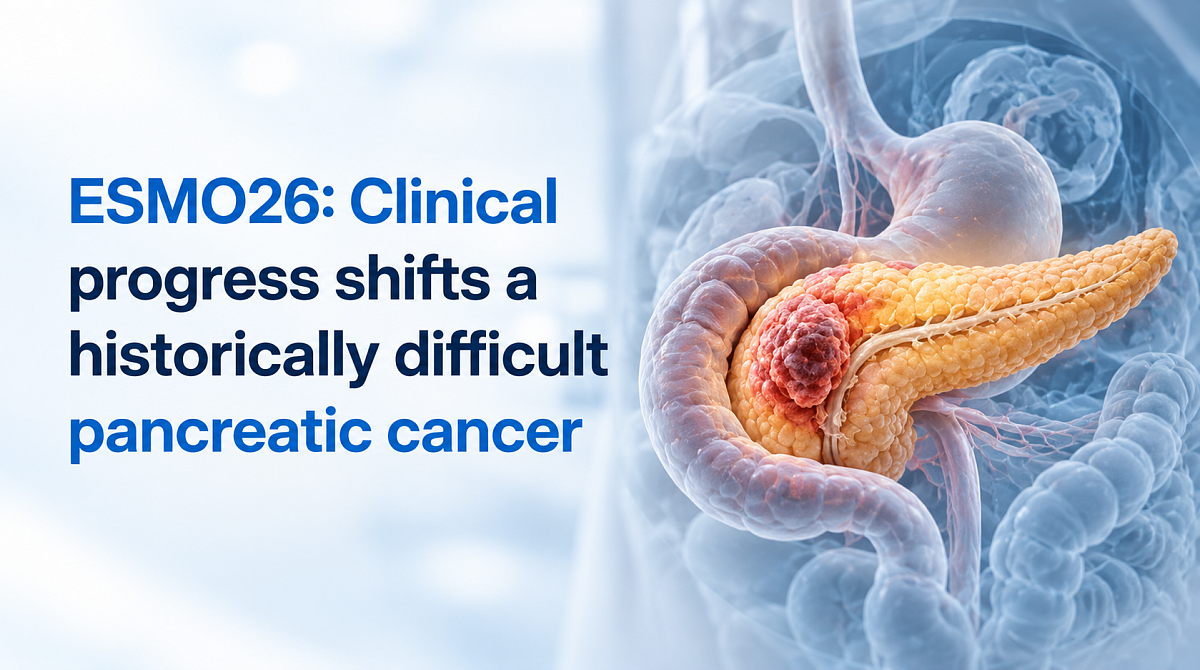
ESMO26: Clinical progress shifts a historically difficult pancreatic cancer landscape
Click to view quick news summary (Spoiler)
Data presented at ESMO 2026 highlighted promising overall survival improvements for pancreatic cancer treated with daraxonrasib, and prostate cancer with abiraterone.
Revolution Medicines’ impressive daraxonrasib data has spurred hope in the pancreatic cancer space. Pancreatic cancer has historically presented a poor clinical outlook, offering patients few effective therapeutic options. Because the disease rarely causes early symptoms, diagnoses typically occur at advanced stages, where a dense, fibrous stroma surrounds tumours and shields them from systemic therapy.
Against this backdrop, data from Revolution Medicines Phase III RASolute 302 trial (NCT06625320) showed a near doubling of overall survival (OS) in patients treated with the daily oral RAS(ON) inhibitor Rasonque (daraxonrasib). The US Food and Drug Administration (FDA) approved the drug in August 2026.
The data showed a median overall survival (OS) of 13.2 months in the investigational arm, compared with 6.7 months in the standard-of-care (SOC) arm.
Although a substantial amount of data has already been released, Revolution presented further findings at the 2026 European Society for Medical Oncology (ESMO) Congress.
Trial investigator Dr Zev Wainberg, a professor of medicine and gastrointestinal medical oncology at UCLA, presented a subgroup analysis stratified by tumour mutational status. For the most common mutation, RAS G12D, which accounted for 43.2% of patients in the study, the overall response rate (ORR) was 32%, compared to 11% in the placebo cohort. In RAS G12V, ORR was 24% compared to 9% in the placebo cohort. OS throughout all of the mutation subgroups favoured Rasonque.
Long-term survival benefit with abiraterone combinations
Adding abiraterone to standard treatment provides a lasting survival benefit for men whose prostate cancer has already spread at diagnosis, reinforcing the value of early treatment intensification.
Data from almost eight years of follow-up in the academically led Phase III PEACE-1 trial (NCT01957436) found that for men with de novo metastatic castration-sensitive prostate cancer, the risk of death was reduced by 25% when adding abiraterone to standard of care (SOC). Median OS was 6.1 years with abiraterone versus 4.6 years without it.
The PEACE-1 trial included 1,173 patients who all received SOC of an ADT, with or without docetaxel chemotherapy. They were then randomly assigned to receive no additional treatment, abiraterone plus prednisone, radiotherapy to the prostate, or both abiraterone plus prednisone and radiotherapy.
Overall, 57% had high-volume disease, indicating more extensive cancer spread. An earlier analysis showed that adding abiraterone to standard of care improved overall survival. Among the 710 men who received ADT plus docetaxel, adding abiraterone plus prednisone reduced the risk of death by 32%. In men with high-volume disease, median survival was 4.6 years with triplet therapy versus 3.5 years with doublet therapy, and almost twice as many were alive at eight years (38% vs 20%). In men with low-volume disease, median survival was 7.8 years with triplet therapy versus 6.2 years with doublet therapy, although this difference was not statistically significant on its own.