



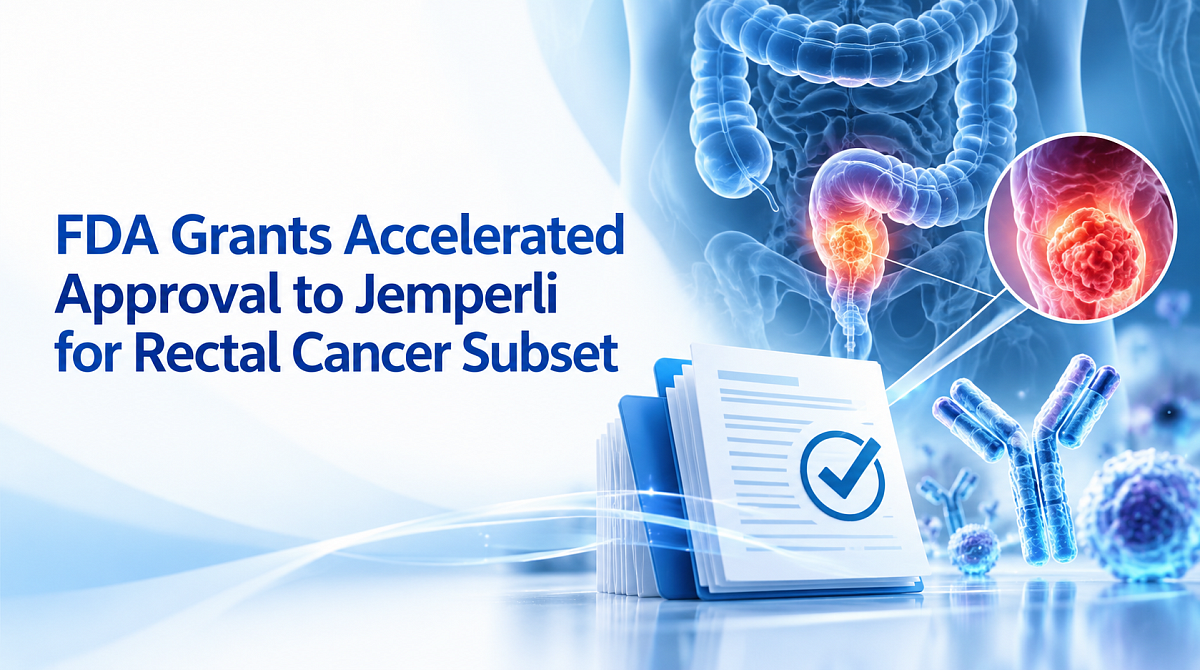
FDA Grants Accelerated Approval to Jemperli for MSI-H/dMMR Locally Advanced Rectal Cancer
Click to view quick news summary (Spoiler)
GSK announced that the FDA granted accelerated approval to Jemperli for adults with a specific subset of locally advanced rectal cancer, providing a new immunotherapy option.
The FDA has approved Jemperli (dostarlimab-gxly) under the accelerated approval pathway for adults with stage II and III microsatellite instability-high (MSI-H)/mismatch repair deficient (dMMR) locally advanced rectal cancer, GSK announced Oct. 19. The regulatory action makes the programmed death receptor-1 (PD-1) antibody the first and only immunotherapy approved for this indication.
The decision extends use of Jemperli into a biomarker-defined subset that accounts for roughly 5% to 10% of rectal cancers.
Tony Wood, chief scientific officer at GSK, said: “Today, Jemperli becomes the first and only approved immunotherapy for adults in the US with MSI-H/dMMR locally advanced rectal cancer. For decades, treatment has relied on chemotherapy, radiation and surgery. This approval offers a new treatment approach and represents an important step towards more personalized care for these patients.”
What Is the Regulatory Pathway for Jemperli in Rectal Cancer?
The FDA based the approval on sustained clinical complete response for 12 months, while continued approval may depend on confirmatory trials, and the label states that the long-term risk of relapse is unknown. The indication had received Fast Track and Breakthrough Therapy designations, and the application then received priority review and a national priority voucher.
FDA acted ahead of the February 2027 action date it assigned in August. The approach took shape in 2023, when an FDA advisory committee voted 8 to 5 that two proposed single-arm trials could be sufficient to characterize the drug’s benefits and risks in this setting. The application is also under review through Project Orbis, an FDA initiative that allows concurrent review by international authorities; reviews in participating countries are ongoing.
What Did the AZUR-1 Trial Show About Jemperli?
Approval rests on AZUR-1, a global, open-label, single-arm phase 2 trial of 154 patients with previously untreated stage II or III disease. Participants received nine cycles of 500 mg intravenous infusions every three weeks over six months.
The primary measure was clinical complete response sustained for 12 months, as determined by independent central review. Independent-review data are still maturing: 47% of 116 evaluable patients (95% confidence interval, 37% to 56%) have reached that milestone, and 38 more still in follow-up have achieved a clinical complete response.
Investigator-assessed data showed 68% of 144 evaluable patients (95% confidence interval, 60% to 76%) reached 12 months. In an exploratory analysis, 76% had no evidence of cancer a year or more after treatment, including 12 patients whose complete response was confirmed by tissue analysis after surgery.
No recurrences have been reported among responders after a median follow-up of more than two years. Serious adverse reactions occurred in 20% of patients, and 3% discontinued treatment because of adverse reactions. The most common were fatigue (32%), rash (22%), diarrhea (18%) and pruritus (17%).
How Does Jemperli Compare With Standard Rectal Cancer Treatment?
Standard care for locally advanced rectal cancer combines chemotherapy, radiation and surgery, which can cause lasting bowel, urinary and sexual dysfunction, secondary cancers and infertility. Tumors with MSI-H/dMMR status cannot properly repair DNA damage, and the resulting accumulation of mutations often makes them responsive to immunotherapy.
Michael Sapienza, chief executive officer of the Colorectal Cancer Alliance, said: “People facing rectal cancer are often thinking not only about treating their disease, but also worrying about what life will look like afterwards. The possibility of avoiding chemotherapy, radiation and surgery represents a meaningful advance for patients and their families. Biomarker testing at diagnosis will be essential to identifying patients who may be eligible for this treatment and helping them understand their options.”
Earlier evidence came from a Memorial Sloan Kettering Cancer Center phase 2 study of single-agent Jemperli, which planned chemoradiotherapy and surgery afterward. All 12 patients in the initial report had a clinical complete response, and no adverse events of grade 3 or higher had been reported.
AZUR-1 tested whether the drug alone could allow patients to avoid those treatments.
What Do the Results Mean, and What Remains Unknown?
Dr. Andrea Cercek, AZUR-1’s principal investigator and section head of colorectal cancer at Memorial Sloan Kettering Cancer Center, said: “The AZUR-1 results demonstrate the potential for a fundamentally different treatment approach in this biomarker-defined patient population, and today’s approval means MSI-H/dMMR patients can now access a licensed treatment tailored to the biology of their disease.”
The press release discloses that Cercek has financial interests related to GSK.
AZUR-1 has no control arm, and the independent-review result designated as the primary objective is lower and less mature than the investigator-assessed figure. Because approval is conditional, longer follow-up and confirmatory evidence will determine whether responses prove durable and whether patients can avoid surgery over time.