



Long Covid Remdesivir Feasibility Trial Reports Results in 73 Patients; Efficacy Still Untested
Click to view quick news summary (Spoiler)
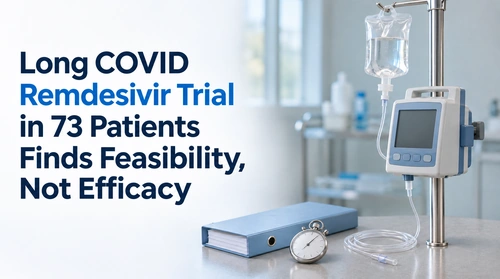
The 73-person ERASE study found five-day remdesivir infusions feasible in long COVID, but did not establish whether the treatment is effective.
Researchers in England reported on 18 November 2026 that a five-day intravenous course of the antiviral remdesivir was feasible and safe to deliver to 73 people with long Covid in the ERASE trial, and that most participants reported less fatigue. The open-label study was not designed to show that the drug works, so the team is asking for a larger randomised trial.
What happened
The University of Plymouth, which manages the trial through its Peninsula Clinical Trials Unit, announced the results on 18 November 2026. The £1.2m ERASE – Long COVID study is led by the University of Derby, and the full report, “An open-label feasibility study of remdesivir in Long COVID: Results from the ERASE LC trial” by Faghy and colleagues, is published in Oxford Open Immunology. Loughborough University, where the lead investigator Professor Mark Faghy is also based, published its own account of the findings.
According to the releases, the study found that delivering a five-day intravenous treatment and carrying out the assessments needed to evaluate it in people with long Covid was safe and feasible. The researchers said that while the project was set up to test feasibility, they also saw encouraging changes in exploratory outcome measures: most participants reported reductions in fatigue, improved quality of life and a longer distance in a timed walking test. The research team is calling for a larger randomised controlled trial to establish whether the antiviral is effective.
The investigators were explicit about the limits of that finding. Professor Faghy said in the Loughborough release: “While ERASE was not designed to tell us whether the treatment caused those changes or whether the treatment works, the findings give us a strong rationale for carrying out a larger randomised controlled trial that will allow us to answer that question.”
Key details of the study
The trial is listed in the ISRCTN registry under ISRCTN72940450 as an open-label clinical feasibility study of remdesivir in post COVID-19 condition. The registry shows that the study has completed, is no longer recruiting, and enrolled 73 participants. Adults aged 18 and over with persistent symptoms after a confirmed SARS-CoV-2 infection were eligible, and healthy volunteers were not.
The registry’s primary outcome measures are about whether a larger trial could be run: screening rates, recruitment rates by pathway and similar process measures, rather than a clinical benefit. Its exclusion criteria include recent treatment with remdesivir, molnupiravir, Paxlovid or another COVID-19 antiviral in the previous six months, a diagnosed compromised immune system, and current participation in a rehabilitation programme aimed at improving long Covid symptoms.
Background and context
The releases cite an estimate that more than two million people in the UK are living with long Covid, with symptoms that include extreme fatigue, breathlessness, palpitations and brain fog. Treatment trials in the condition have so far had mixed fortunes. In 2024, CIDRAP reported on STOP-PASC, a Stanford University trial of 155 adults with moderate to severe long Covid who were randomised 2:1 to a 15-day course of oral Paxlovid or placebo. The trial found the course was safe but produced no statistically significant difference in pooled symptom severity.
The larger RECOVER-VITAL trial tested whether longer courses of Paxlovid could help by targeting virus that may persist in the body. The NIH-funded study, described in a RECOVER Initiative news release dated 31 August 2026, recruited 959 adults at 69 sites across the United States and concluded that Paxlovid did not affect long Covid symptoms compared with placebo. CIDRAP’s report adds that the double-blind trial compared Paxlovid for 25 days, Paxlovid for 15 days followed by placebo, and ritonavir plus placebo, and found no statistically significant benefits in any of the three symptom groups.
ERASE differs from those trials in two ways that matter for interpretation. It tested a different antiviral, remdesivir, which is given by infusion rather than as tablets, and it was an open-label feasibility study with no placebo comparison. Open-label means that participants and clinicians knew what was being given, which is one reason improvements in self-reported symptoms cannot be attributed to the drug. That is the distinction the investigators drew in their own statements.
What it means for researchers, universities and research offices
For trialists, ERASE is a worked example of a pilot study doing its intended job: it was designed to answer operational questions, and its registered primary outcomes are about recruitment, screening and delivery, not efficacy. Teams planning a definitive randomised controlled trial in long Covid can use the feasibility results on assessment burden and recruitment pathways, but should treat the symptom changes as hypothesis-generating. The earlier placebo-controlled Paxlovid results show why a control arm is likely to matter in a condition where symptoms fluctuate and are self-reported.
For research offices and sponsors, the registry record is a useful template for transparency. The trial was registered with ISRCTN, its ethics approval reference and committee are published, and the industry funder is named, which lets readers judge the funding relationship when a larger trial is proposed. Gilead Sciences is listed in the registry as the funder. Offices negotiating industry-funded academic trials can check how such funding is declared against the arrangements described in the guidance on industry-sponsored research authorship.
The study also shows a multi-institution delivery model: a university sponsor, an NHS clinical trials unit’s methodological partner, testing at university facilities and treatment in NHS hospitals. Research administrators supporting similar designs will recognise the contract, data-handling and research ethics committee workload that comes with splitting assessments and treatment across sites. The Plymouth release says the clinical trials unit’s role was to ensure the study was managed correctly and that data from hospitals and the research team were handled in line with ethical and medical guidelines.