



New liquid biopsy technology can detect disease from a drop of blood
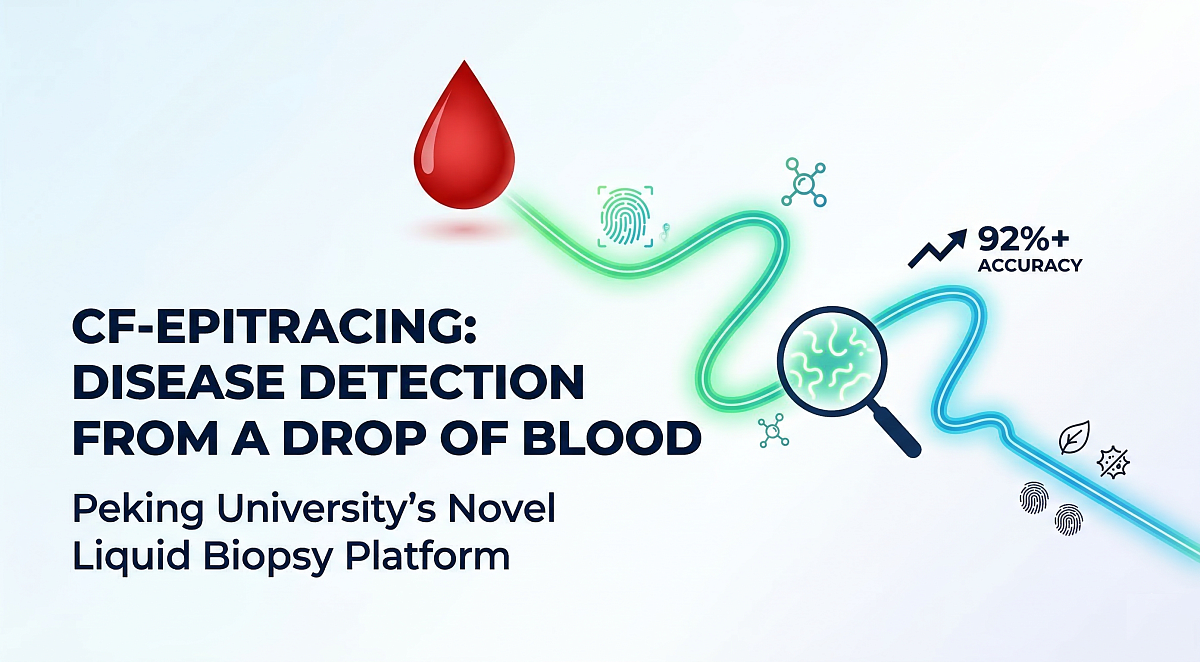
An innovative platform developed by Peking University researchers called "cf-EpiTracing" has proved capable of detecting and tracing diseases from as little as 50 μl of human plasma, or roughly a drop of blood. The research, published in Nature on March 4, 2026, was led by Professor He Aibin from the College of Future Technology and Professor Jing Hongmei from the Department of Hematology, PKU Third Hospital.
Overcoming Current Diagnostic Limitations
Current liquid biopsies struggle to pinpoint where disease signals originate, limiting their use. This new "cf-EpiTracing" platform overcomes that by capturing detailed epigenetic fingerprints from trace blood samples. It can identify the specific tissues driving a disease, distinguish lymphoma subtypes, and predict patient outcomes better than existing clinical tests, paving the way for earlier, more precise non-invasive diagnoses.
Breakthroughs in Colorectal Cancer and Lymphoma
In the field of early diagnosis and screening for colorectal cancer, cf-EpiTracing has delivered impressive results. By integrating multimodal epigenomic features from cell-free chromatin and leveraging machine learning algorithms, cf-EpiTracing reaches an accuracy rate of up to 97.6% in training group samples, and remains robust at 92.2% in independent validation group samples.
In another notable discovery, the technology uncovered that patients with diffuse large B cell lymphoma exhibit stronger signals of CD34-positive cells in their plasma, potentially reflecting bone marrow involvement and disease aggressiveness. This finding offers new insights for lymphoma subtyping and treatment strategies.
The Future of Multi-Omic Diagnostics
Future directions include integrating cf-EpiTracing with other cell-free modalities such as DNA methylation, mutations, and chromatin topology. This multi-omic approach promises unprecedented precision in diagnosing complex diseases and monitoring cellular dynamics during disease progression and treatment in large patient cohorts, potentially transforming non-invasive diagnostics across multiple clinical scenarios.