



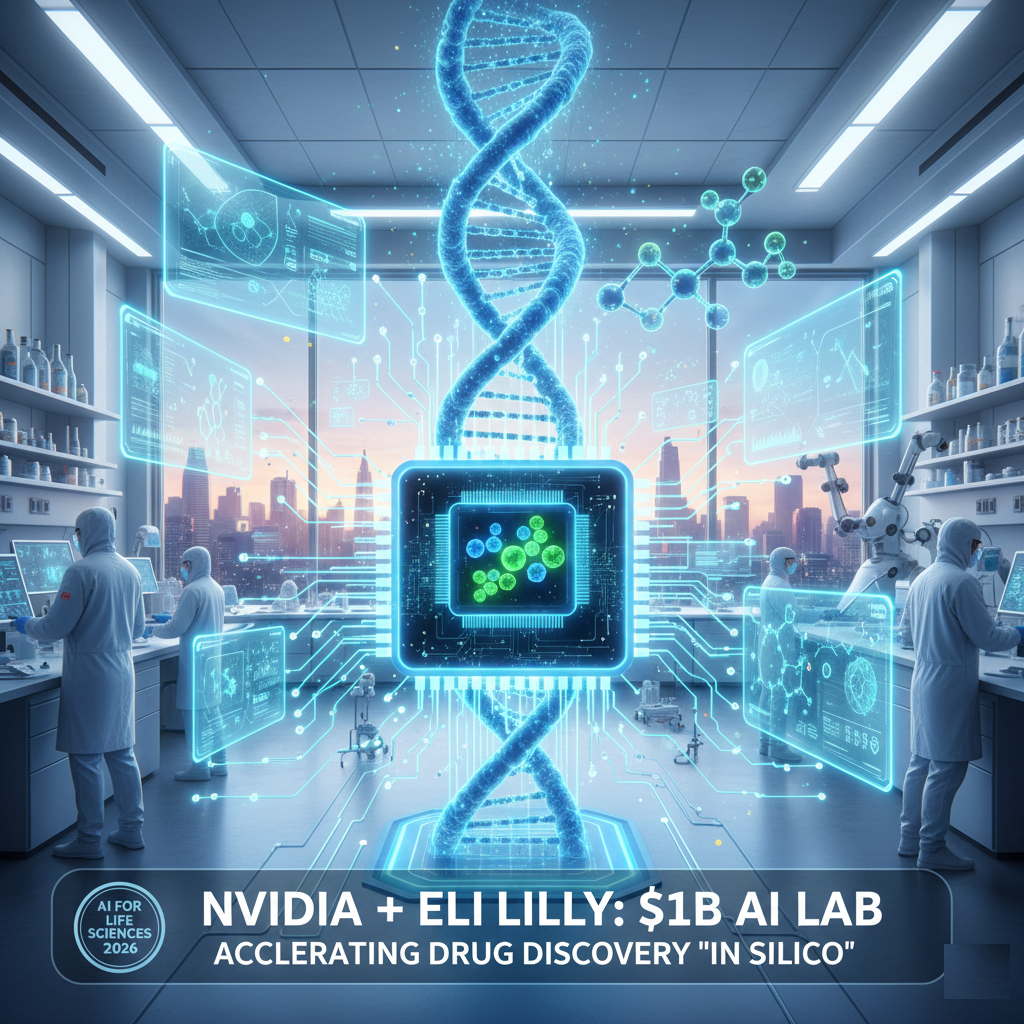
Nvidia and Eli Lilly to Invest $1 Billion in Groundbreaking AI Medical Research Lab
Nvidia Corp. has announced a historic partnership with Eli Lilly and Co. to establish a state-of-the-art research facility dedicated to the intersection of artificial intelligence and biotechnology. The companies have committed up to $1 billion to open this hub in South San Francisco later this year, aiming to fundamentally accelerate the pharmaceutical drug discovery timeline.
The lab will merge Nvidia’s unparalleled AI expertise with Lilly’s clinical research depth to create a continuous learning system. This facility will operate autonomous experiments 24/7, generating high-fidelity data to refine AI models that automate complex pharmaceutical research tasks.
At the core of the lab’s computational power are Nvidia’s newest high-performance chips. The infrastructure is built to handle massive inference workloads and complex biological simulations with unprecedented efficiency.
Researchers at the new facility will leverage BioNeMo, Nvidia's specialized toolkit for the life sciences. This platform enables the development of equivariant neural networks—algorithms capable of understanding the precise geometric and 3D properties of complex molecules.
| Platform | Application | Availability |
|---|---|---|
| BioNeMo | Molecular simulation and model training | Internal Research Hub |
| Clara Models | Medical device data analysis | Lilly TuneLab Platform |
| Lilly TuneLab | Proprietary data + Neural networks | Available to select Biotechs |
Beyond molecular discovery, the lab will use Nvidia Omniverse to revolutionize medicine production. By creating digital twins—virtual, real-time replicas of physical production lines—Lilly plans to stress test manufacturing workflows and optimize global supply chains without interrupting physical operations.
For the global R&D community, this $1B investment marks the definitive arrival of "In Silico First" research. The ability to simulate vast chemical and biological spaces with high accuracy before laboratory synthesis represents a paradigm shift in how the next generation of life-saving therapies will be brought to market.