



Palisades Therapeutics Reports Promising Preclinical Results in Prostate Cancer Across Two Distinct Drug Programs
Click to view quick news summary (Spoiler)
Palisades Therapeutics reported preclinical evidence for PT150, PT157 and PT162 in prostate cancer, including treatment-resistance models.
CLIFFSIDE PARK, NJ, UNITED STATES, November 19, 2026 — Pop Test Oncology LLC, doing business as Palisades Therapeutics (PT), a clinical-stage biopharmaceutical company developing proprietary small-molecule therapeutics, today announced encouraging preclinical findings across two distinct prostate cancer programs. The results demonstrate the potential of PT150/PT157 to address treatment resistance and tumor-cell dissemination, while PT162 has shown significant primary-tumor inhibition in two separate evaluations, most recently in November 2026.
PT150: An oral drug candidate from the platform, currently in Phase 2 clinical trials. It acts as a selective modulator of glucocorticoid and androgen receptors (AR/GR). Initially investigated for the treatment of depression, post-traumatic stress disorder (PTSD), and alcohol dependence, it has recently demonstrated high efficacy in oncology—including prostate and pancreatic cancers—as well as in preventing weight gain following the discontinuation of GLP-1 receptor agonist injections (such as semaglutide).
PT157: A preclinical dimer (a modified analog) of PT150. It exhibits enhanced synergistic activity and requires lower therapeutic doses. In studies conducted by the National Cancer Institute (NCI), the combination of PT157 with conventional therapy was shown to reduce metastasis and disrupt the mechanisms by which tumors develop resistance to treatment.
Notably, PT157 combined with enzalutamide (Xtandi) demonstrated significantly greater inhibition of tumor-cell dissemination than Xtandi alone in the same preclinical model. Separately, PT150 and PT157 retained activity in prostate cancer cell models where Xtandi had lost effectiveness or produced limited responses.
Research Collaboration and Independent Scientific Support
The prostate cancer research is being conducted by the translational research group led by Sujit S. Nair, PhD; Dimple Chakravarty, PhD; and Ashutosh K. Tewari, MD, from the Department of Urology and Mount Sinai Tisch Cancer Center, Icahn School of Medicine at Mount Sinai, in collaboration with Gabriela Vazquez Rodriguez, PhD, and Lasse Jensen, PhD, of BioReperia, Sweden.
Independent screening through the National Cancer Institute’s Developmental Therapeutics Program has demonstrated growth-inhibitory activity for clinical-stage, orally administered PT150; its preclinical dimer, PT157; and preclinical PT162 in prostate cancer cell lines, providing additional support for the company’s oncology programs.
Two Distinct Therapeutic Approaches
PT150/PT157 — Targeting Treatment Resistance and Tumor-Cell Dissemination
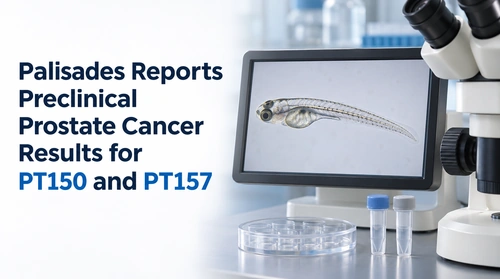
In a June 2024 BioReperia zebrafish xenograft study, PT157 combined with enzalutamide reduced mean disseminated tumor-cell counts by approximately 40–45% compared with enzalutamide alone. The combination demonstrated statistically significant improvement over either individual treatment (p < 0.01).
Additional studies involving human-derived prostate cancer cell clones selected through prolonged enzalutamide exposure demonstrated activity with PT150 and PT157 where enzalutamide alone had lost effectiveness or showed borderline responses.
These findings support the potential for PT150/PT157 to complement existing androgen-targeted therapies by addressing biological pathways associated with adaptive treatment resistance and tumor-cell dissemination.
In October 2026, Palisades Therapeutics and collaborating investigators published a peer-reviewed Perspective in Frontiers in Pharmacology examining glucocorticoid receptor modulation and inflammatory signaling across chronic diseases, including cancer. Drawing upon findings from seven complementary experimental approaches, the publication highlights the potential importance of GR-mediated stress responses and NF-κB-associated inflammatory pathways, providing additional scientific context for the company’s PT150/PT157 oncology program.