



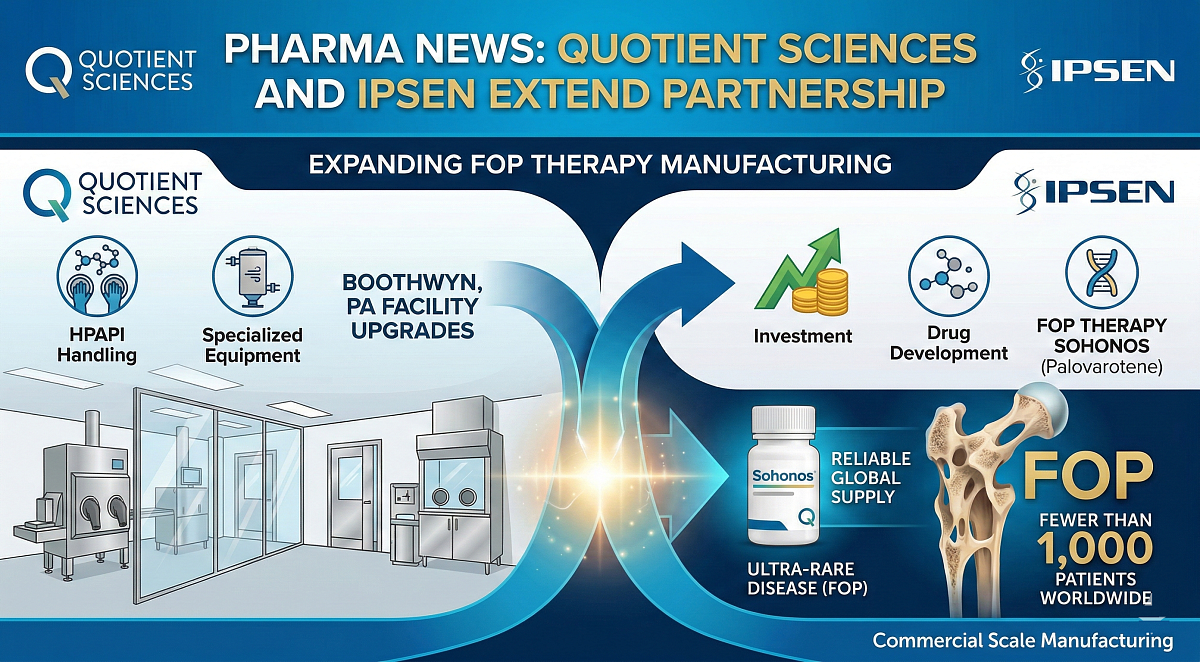
Quotient Sciences has extended its commercial partnership with Ipsen, focusing on the production of Sohonos (Palovarotene) for fibrodysplasia ossificans progressiva (FOP). The agreement includes Ipsen’s investment in additional equipment at Quotient Sciences’ facility in Boothwyn, Pennsylvania, US.
FOP is an ultra-rare condition, impacting fewer than 1,000 people worldwide.
Enhanced HPAPI Manufacturing Capabilities
The collaboration involves containment, specialised handling, and sustained supply of this highly potent molecule. As part of the extended agreement, the aforementioned investment by Ipsen provides critical additional equipment at the Boothwyn facility.
This comprises a Pneumatic Closed Transfer System, which maintains blend integrity during safe material transfer, and a Flexible Dispensing Isolator designed to improve operator safety and remove the need for specialised cleaning procedures.
Expanded Capacity: Quotient Sciences now has expanded capabilities for handling highly potent active pharmaceutical ingredients (HPAPI) and products with occupational exposure limits (OELs) at or below 1µg/m³. The new additions also allow seamless integration with existing equipment, facilitating the production process for complex drug molecules.
Ensuring Global Commercial Supply
The extended partnership aims to guarantee a reliable commercial supply of FOP therapy while expanding capacity to handle multiple highly potent compounds at commercial scale. This supports the need for flexible solutions in treating rare diseases where patient populations are small and product volumes are limited.
Ipsen selected Quotient Sciences for its established operational capabilities and extensive experience in managing global shipments. The company will be responsible for ensuring the secure and timely delivery of the therapy to international markets.
In related news, earlier in September 2025, Quotient Sciences entered a partnership with the UK’s Centre for Process Innovation (CPI) to expedite the creation of ribonucleic acid (RNA)-based treatments.