



SBE303 Receives FDA Fast Track Designation in Pretreated Urothelial Cancer
Click to view quick news summary (Spoiler)
The FDA awarded fast track designation to Samsung Bioepis's SBE303, an investigational ADC intended for patients with advanced urothelial cancer.
The FDA has granted fast track designation to SBE303 for the treatment of patients with locally advanced or metastatic urothelial cancer who previously received enfortumab vedotin-ejfv (Padcev). The investigational Nectin-4–targeted antibody-drug conjugate (ADC) is under evaluation in a first-in-human, open-label, multicenter phase 1 study (NCT07524348) enrolling patients with advanced solid tumors that are refractory to prior therapy.
Nonclinical data presented at the 2026 AACR Annual Meeting showed that SBE303 significantly inhibited tumor growth vs vehicle controls at week 3 in several Nectin-4–positive cell line–derived xenograft models, one of which was urothelial cancer. In cynomolgus monkeys given repeat intravenous doses, SBE303 was tolerated at 40 mg/kg per dose. Investigators observed no severe systemic toxicity and no unexpected on-target findings, including in the skin. Drug-related changes were minimal to moderate in severity and resolved by the end of the recovery period.
"The FDA’s fast track designation for SBE303 reflects the critical unmet medical need in patients with advanced solid tumors and recognizes the therapeutic rationale of targeting Nectin-4 with our next-generation ADC candidate,” Byoungin Jung, vice president and regulatory affairs team leader at Samsung Bioepis, stated in a news release. “We look forward to working collaboratively with the FDA to guide our clinical development program efficiently and advance SBE303 through each stage of evaluation,”
What is the mechanism of action of SBE303?
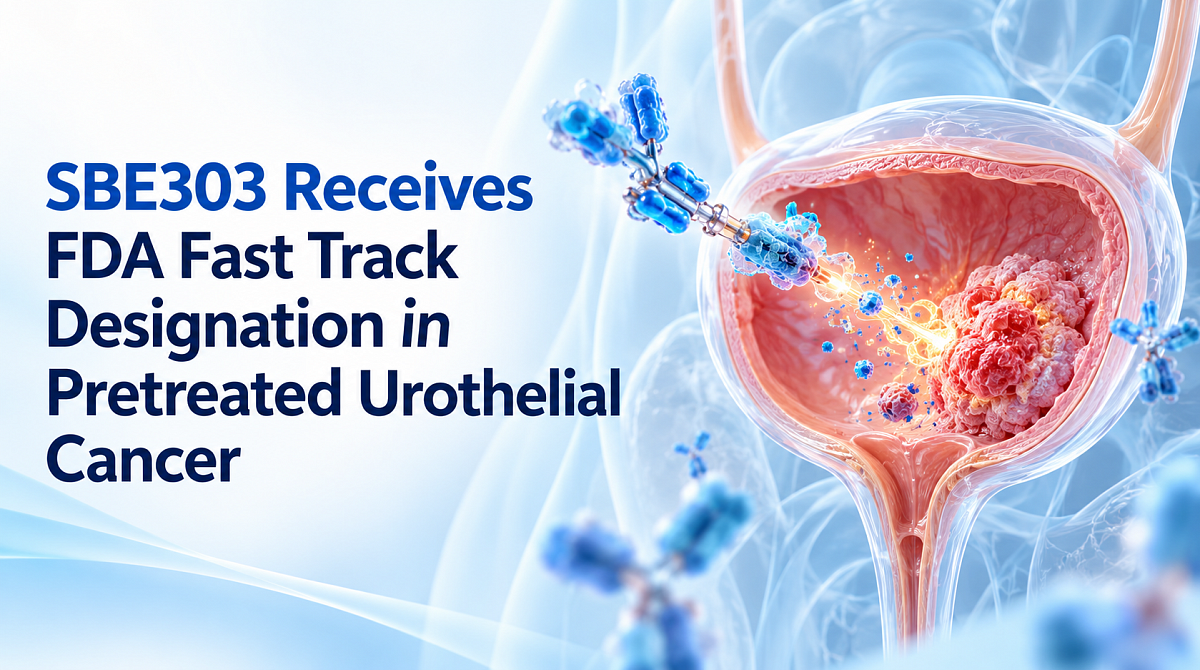
SBE303 pairs an anti–Nectin-4 antibody with a novel topoisomerase I inhibitor payload, joined by a proprietary beta-glucuronide–based cleavable linker.3 Nectin-4, an adhesion protein, is found on tumor cells in several cancer types, including urothelial, lung, and breast cancers. Once SBE303 binds Nectin-4, the conjugate is internalized and transported to lysosomes, where beta-glucuronidase cuts the linker to free the payload.3 The payload then blocks topoisomerase I activity, killing the cancer cell. In pharmacokinetic studies conducted in mice, rats, and monkeys, exposure to the intact ADC closely tracked that of total antibody, and free-payload exposure was low, suggesting that the linker remains stable in the bloodstream.
How is the phase 1 trial designed?
The trial aims to enroll 149 adult patients with unresectable locally advanced or metastatic solid tumors confirmed by histology. To qualify, patients must have experienced disease recurrence or progression on or after standard therapy, be intolerant of or have declined standard treatment, or have no standard option available.
Enrolled patients are receiving SBE303 as monotherapy.
The primary end points are the incidence of adverse effects (AEs) and serious AEs, dose-limiting toxicities during the first treatment cycle, and confirmed objective response rate at 32 weeks per blinded independent central review using RECIST 1.1 criteria. Secondary end points include tumor response, disease control rate, pharmacokinetic parameters, and the incidence of antidrug and neutralizing antibodies.