



Thalidomide shows potential for treating rare brain vascular malformations
Click here to view quick news summary (Spoiler)
A research group at Xuanwu Hospital has established a specialized KRASG12V mouse model matching human sporadic central nervous system arteriovenous malformations. Utilizing this platform alongside clinical findings from 28 patients, the team proved that thalidomide reduces vascular hemorrhages and restores integrity by lowering toxic ANGPT2 levels.
A team at Xuanwu Hospital, Capital Medical University, has identified thalidomide as a potential treatment for sporadic central nervous system arteriovenous malformations using a novel Researchers at Xuanwu Hospital, Capital Medical University have reported encouraging preclinical and early clinical evidence that thalidomide may help stabilise and reduce rare vascular malformations affecting the brain and spinal cord.
Central nervous system arteriovenous malformations (CNS-AVMs) are abnormal tangles of blood vessels that create direct, high-flow connections between arteries and veins. These lesions can lead to haemorrhagic stroke, seizures, headaches, neurological impairment and progressive disability, particularly in children and young adults. While treatments such as microsurgery, embolisation and stereotactic radiosurgery can be effective, they are invasive and may carry significant risks, especially for patients with complex lesions. As a result, a safe and effective drug-based therapy is needed.
New Disease Model Enables Drug Discovery
One of the biggest barriers to developing medicines for sporadic CNS-AVMs has been the lack of animal models that accurately reflect the human disease. To overcome this, the researchers developed a mouse model of brain arteriovenous malformation driven by the KRASG12V mutation, which is associated with sporadic CNS-AVMs in humans. The model successfully reproduced many of the key characteristics of the disease, including feeding arteries, a central vascular nidus, draining veins, abnormal blood flow, haemorrhagic changes and impaired vessel integrity. KRASG12V-driven mouse model and exploratory clinical data from 28 patients.
By comparing gene-expression profiles from both human and mouse lesions, the team identified strong similarities between the two. They then used the Connectivity Map platform, a tool that predicts compounds capable of reversing disease-related molecular signatures. Among approved medicines, thalidomide emerged as one of the most promising candidates.
Vascular Stabilization Mechanisms
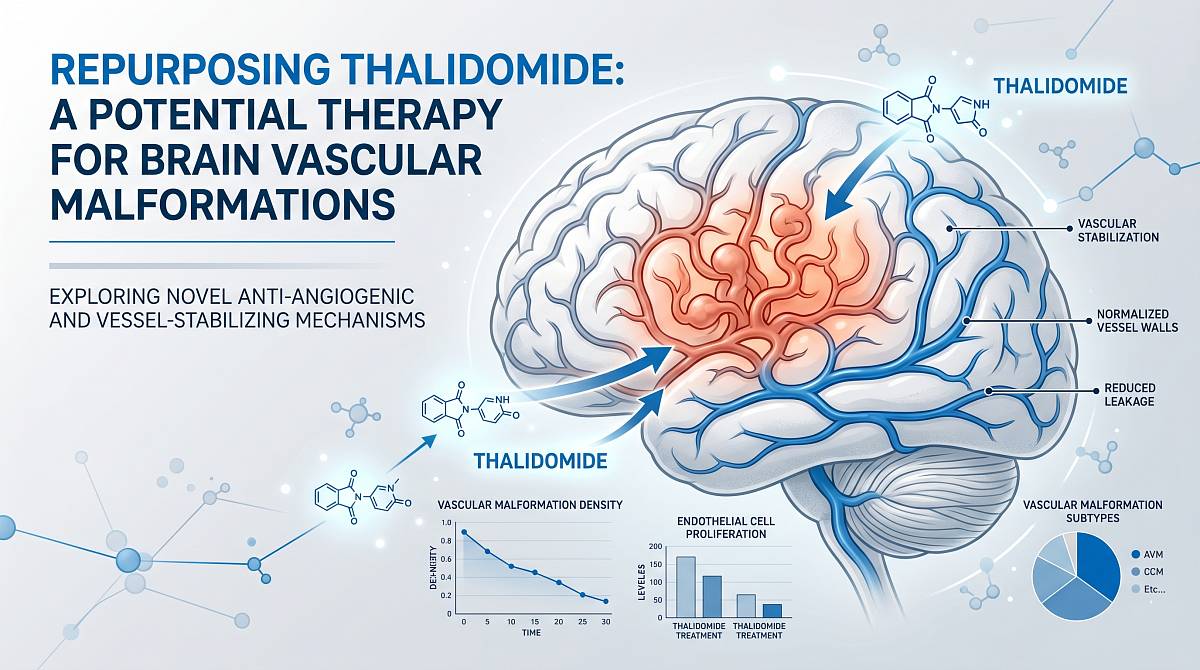
When administered to mice with brain arteriovenous malformations, thalidomide produced a range of beneficial effects. The treatment improved survival rates, reduced lesion growth and haemorrhage, lowered abnormal blood-flow velocity and improved neuromuscular function. Researchers also observed increased coverage of malformed blood vessels by mural cells, which play a key role in maintaining vascular stability. The findings suggest that thalidomide may help transform fragile and unstable blood vessels into more mature vascular structures.
Further investigation revealed a possible mechanism behind these effects. The drug reduced levels of angiopoietin 2 (ANGPT2), a molecule associated with vascular instability and abnormal communication between endothelial and mural cells. Blocking ANGPT2 directly with a neutralising antibody produced similar therapeutic benefits in the mouse model, reinforcing the molecule’s potential role in disease progression.