




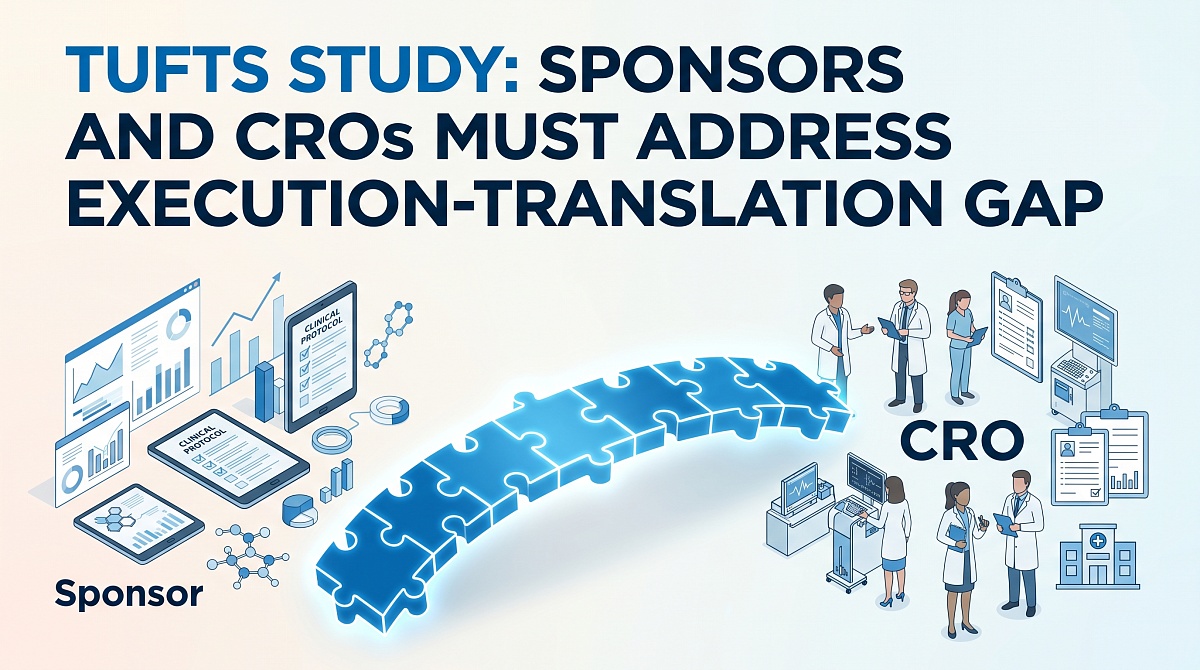
Sponsors, CROs must address growing ‘execution translation gap,’ Tufts study finds
Click to view quick news summary (Spoiler)
A new Tufts Center study shows that while sponsors and CROs effectively identify clinical trial risks, they face a growing "execution translation gap" leading to a 56% surge in protocol deviations.
Research shows pharma companies identify clinical trial risks well but lack the organizational capability to implement effective solutions. Protocol deviations jumped 56% in five years, rising from 189 per trial in 2020 to 296 in 2024. Half of Phase III trial sites fail to enroll patients or miss targets, a problem unchanged for 20 years. Regulatory guidelines like ICH E6 and E8 can help close the execution gap through better risk management. Sponsors and CROs are effective at detecting problems with trials, but they are less adept at taking corrective action, according to new analysis.
Research by the Tufts Center for the Study of Drug Development suggests this “execution translation gap” reflects a breakdown in organizational capability that is having a detrimental impact on clinical trials.
“This gap reflects the systemic inability to convert well-identified problems into coordinated, timely, and effective action. In a domain as complex and interdependent as clinical trials, this gap manifests in the failure to mobilize cross-functional teams, align incentives, adapt processes, and implement corrective strategies and tactics. The execution translation gap is not a deficit of knowledge; rather, it is a failure to execute clinical activities efficiently and effectively. Its consequences are measurable, material, and growing,” authors Kenneth Getz and Kenneth Kaitin wrote.
Protocol deviations are an example of these consequences, according to the authors, who pointed to a 56% increase in the mean number of deviations per trial over the past five years—up from 189 in 2020 to 296 last year—to support their argument.
“This trend suggests that root causes are not being effectively addressed. Instead, corrective actions are localized and transient, failing to achieve systemic learning,” they wrote.
Enrollment challenges are another consequence of the execution translation gap, according to Getz and Kaitin, who noted that half of all sites in any global Phase III trial either fail to enroll any patients or under-enroll relative to targets.
“This distribution has remained remarkably stable for over two decades, indicating systemic inefficiencies in site selection and activation. Despite advances in feasibility assessment and data-driven site identification, execution at the site level continues to fall short,” they wrote.