



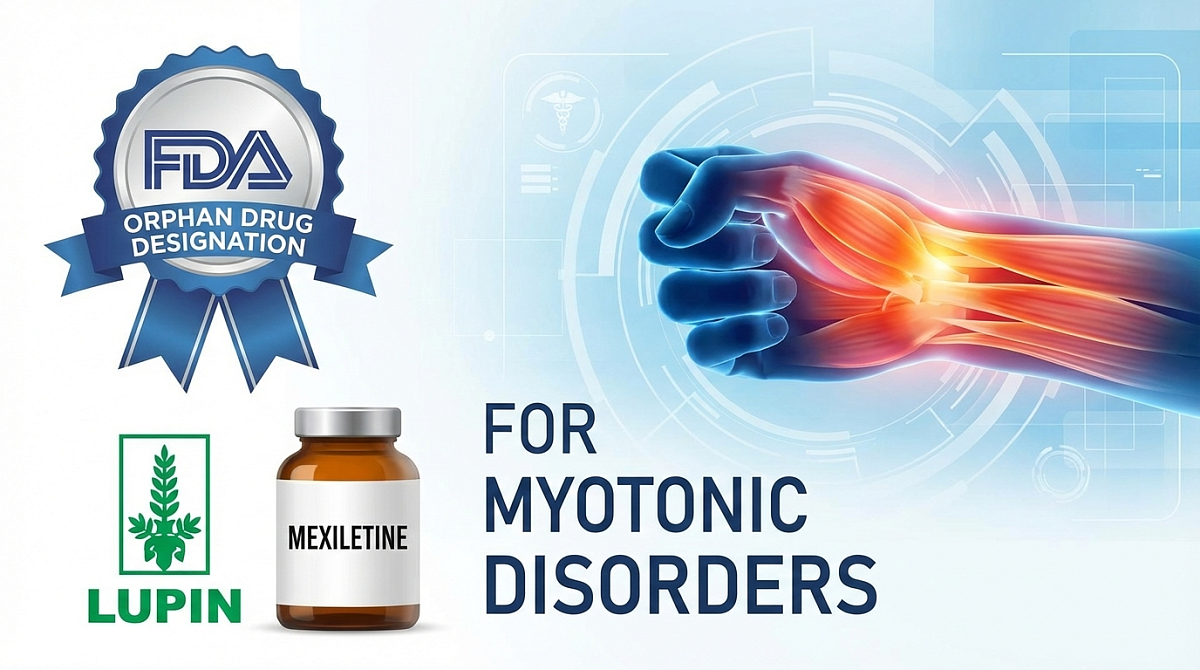
U.S. FDA Grants Mexiletine Orphan Drug Designation for Myotonic Disorders
- Company: Lupin Limited
- Drug: Mexiletine Hydrochloride
- Status: Orphan Drug Designation
- Indication: Myotonic Disorders
- Mechanism: Sodium Channel Blocker
Pharma major Lupin announced today that the US Food and Drug Administration (U.S. FDA) has granted Orphan Drug Designation (ODD) to mexiletine hydrochloride for the treatment of myotonic disorders.
— Vinita Gupta, CEO, Lupin Limited
Myotonic Disorders and Non-Dystrophic Myotonic (NDM)
Myotonic disorders are a group of heterogeneous, inherited, neuromuscular disorders characterized by a shared symptom called myotonia. Myotonia is described as an inability to relax a contraction of skeletal muscle which originates from a voluntary muscular contraction such as shaking someone’s hand and blinking, or everyday activities such as walking across a street and climbing stairs. Taken together, these myotonic disorders are rare and comprise two groups: the myotonic dystrophies and the non-dystrophic myotonic disorders.
Myotonic Dystrophy (DM)
Myotonic dystrophy (DM) affects multiple systems in the body. The two types of DM (DM1 and DM2) differ in prevalence, affected genes, disease progression, symptoms and severity of symptoms. DM1 is the most common form, with the global consensus that myotonic dystrophies, based upon estimates from the NIH and others for western European and North American populations, affect 12.5 per 100,000 individuals.
Non-Dystrophic Myotonias (NDM)
Non-dystrophic myotonias (NDM) are caused by mutations within ion channels in the sarcolemma membrane of skeletal muscles and affects 1 in 100,000 people. Non-dystrophic myotonias exhibit both sodium and chloride channelopathies which result in altered membrane excitability. Unlike DM, for patients with NDM myotonia is the most prominent symptom and demonstrates different phenotypes in subgroups of NDM disorders.
Myotonia in NDM patients has an onset in childhood and persists across their lifetime. Myotonia is described by patients in a variety of ways (stiffness, cramps, pain, difficulty releasing a fist, or difficulty swallowing or eating) which can contribute to substantial delays in diagnosis and treatment, leading to decreased patient quality-of-life and often significant disability.
Mexiletine Clinical Efficacy
In randomized controlled trials in adult patients with non-dystrophic myotonia, mexiletine (167 to 500 mg/day) has been shown to significantly reduce myotonia compared to placebo. It works by reducing skeletal muscle hyperexcitability through its use-dependent, voltage-gated, sodium channel blocking actions which are independent of the cause of channel function.
This resulted in an improvement in patient quality-of-life and other functional outcomes, with gastro-intestinal discomfort reported as the most common adverse event, demonstrating mexiletine to be safe and well tolerated in this patient population.