




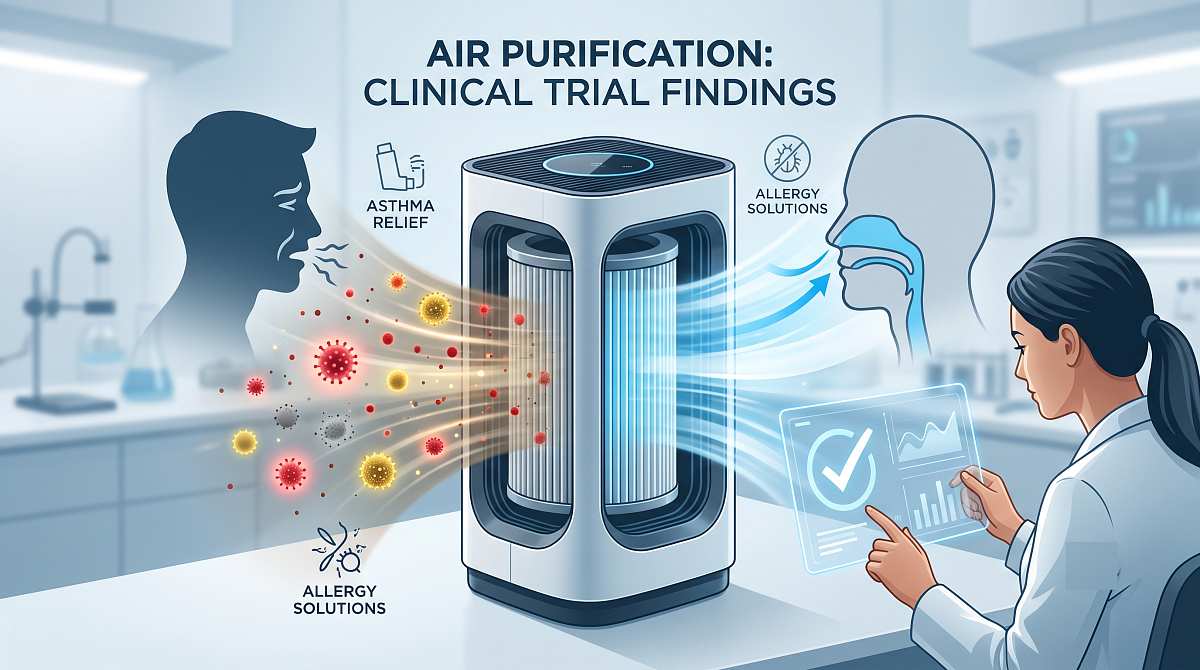
Clinical Trial: Largest trial for allergy and asthma control
Click to view quick news summary (Spoiler)
A two-year clinical trial conducted by UC Davis and CARB reveals that standalone high-efficiency air purifiers using HyperHEPA technology significantly reduce airborne allergens, improving respiratory health and asthma symptoms.
Allergy season often brings elevated allergic reactions and asthmatic symptoms, limiting outdoor activities and open-air ventilation. Airborne allergens and pollutants can easily stick to clothing and sneak into indoor spaces undetected, impacting home air quality.
The University of California, Davis in partnership with the California Air Resources Board (CARB) conducted the largest double-blind, placebo-controlled clinical trial to determine the most optimal air cleaning technology to properly eliminate allergen and pollutant particles.
UC Davis and the CARB tested air purification tools against central filtration vents to measure each device’s particle reduction and asthmatic symptom improvement.
Clean air testing environment
Conducted by UC Davis researchers and funded by the CARB, the two-year study explored different filtration methods and their effects on pollutant particle removal within 172 various households in California. The study also measured air cleaning technology’s improvement of respiratory symptoms, surveying 191 asthmatic children ages 6-12. As a double-blind, placebo-controlled study, researchers aimed to minimize errors while producing comparative data. The study determined the filtration efficiency power and pollutant removal rates between personal single-room air purifiers and central filtration systems.
Allergy and pollutant purification research
UC Davis researchers examined the removal rates of air cleaning devices and central filtration systems on various airborne pollutants, including PM0.2, PM2.5, and PM10. PM0.2 is all particulate matter that is 0.2 microns in diameter or less, while PM2.5 includes particles 2.5 microns or less in size and PM10 is equivalent to 10 microns or less. During each household trial, either central air filtration or two stand-alone air purifiers were tested for pollutant removal rates compared to if there were no purification methods used.
On average, high-efficiency filtration and air purification methods were able to capture 48% more ultrafine particles compared to no air cleaning device utilization. Out of the two high-efficiency devices tested, personal air purifiers removed the greatest percentage of ultrafine pollutants at 52%. Without proper treatment, airborne pollutants and ultrafine particles could elevate health risks through long-term exposure, such as asthmatic symptoms, respiratory complications, and irritable allergies.
Optimal allergy filtration and asthma prevention
High-efficiency, ultrafine particle control helps secure clean air quality and minimize airborne pollutants by utilizing air cleaning with advanced filters. HyperHEPA air purifiers are specifically designed to capture ultrafine pollutants, removing 99.5% of harmful particles up to 0.003 microns in size. HyperHEPA filters target common indoor pollutants that can cause allergic reactions or asthmatic flare-ups, such as: Pollen, Pet dander, Wildfire smoke, Dust, Bacteria, Viruses, PM2.5, PM10.
For comprehensive air quality protection, multilayered filtration systems with Activated Carbon filters remove lingering odors, gaseous emissions, and volatile organic compounds. Air quality awareness is also just as important as the air cleaning technology itself. Indoor and outdoor air quality monitors can help plan daily schedules accordingly and determine when ventilation is safe.
Clinical improvement through air cleaning technology
According to UC Davis researchers, participants in the study reported about 20% less clinic visits and a slight reduction in healthcare utilization overall, especially for those with severe asthmatic conditions. A larger reduction of pollutants was observed when participants kept windows closed and ran air cleaning systems for the full duration of the study.
Participants with air cleaning devices reported waking up fewer times during the night from asthmatic symptoms if bedroom doors were also closed. Extended air purifier runtimes combined with closed windows and doors can help air purifiers run more efficiently, providing effective filtration and maximized health protection.
Conclusion
High-efficiency filtration can remove airborne pollutants and ultrafine particles, providing relief for allergic reactions and asthmatic symptoms. Out of the two high-efficiency filtration devices tested, standalone air purifiers captured the greatest percentage of pollutants, eliminating even the smallest of particles with HyperHEPA technology.
IQAir stand-alone air cleaners used in the study led to a 20% reduction in the sum of clinic visits, ER visits, and hospitalizations and a reduction in waking due to asthma when bedroom doors were kept closed. The most significant improvement was seen among severe asthmatics.
Allergies and asthma can be difficult obstacles when going about your daily schedule, but with high-efficiency filtration, airborne pollutants can be easily captured and respiratory concerns swiftly alleviated.
About IQAir
IQAir is a Swiss technology company that empowers individuals, organizations and governments to improve air quality through information and collaboration.