



Researchers link fructose to ovarian cancer spread — ScienceDaily
Click to view quick news summary (Spoiler)
Preclinical experiments suggest fructose released by chemotherapy-surviving ovarian cancer cells may weaken neighboring cells' connections and facilitate spread.
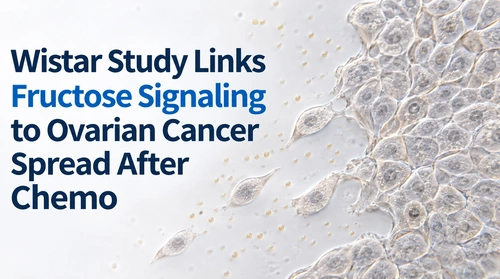
Researchers at the Wistar Institute found that ovarian cancer cells that survive chemotherapy can release fructose. In preclinical experiments, this sugar acted as a signal for neighboring tumor cells, weakening their connections and potentially facilitating spread. The findings, published in the journal Nature Aging, are reported by ScienceDaily.
A signal from cells after chemotherapy
Most ovarian cancer patients receive chemotherapy with platinum-based drugs, which damage the DNA of cancer cells and prevent them from multiplying. At the same time, some cells can survive treatment even if they no longer divide. According to the researchers, such cells remain biologically active and release substances that affect the tumor environment.
The scientists separately studied cells that survived treatment and the substances they released. In a preclinical model, these substances alone, without the presence of the cells themselves, significantly increased cancer spread. Further analysis pointed to fructose, a naturally occurring sugar found in fruit, honey, table sugar, and high-fructose corn syrup.
Effect on cholesterol synthesis
Experiments, including those using CRISPR screening, showed that fructose suppresses cholesterol production in neighboring cancer cells. Cholesterol is an important component of cell membranes and helps maintain connections between cells. When its synthesis declines, these connections weaken, making it easier for cells to separate from one another.
In preclinical experiments, high fructose intake comparable to the consumption of sweetened beverages also promoted signals associated with cancer spread, even without chemotherapy. At the same time, the authors stress that the study does not prove that sugar consumption causes metastasis in people, and the effect of reducing fructose on treatment outcomes for patients has not yet been tested.
Questions about statins
The team also tested the effects of statins, drugs that reduce cholesterol production. In experiments, these medicines on their own could weaken connections between ovarian cancer cells. The scientists are studying whether this can affect the effectiveness of chemotherapy in certain situations. There are currently no results from studies involving patients, so the authors specifically cautioned that these data are not grounds for stopping prescribed statins.