



AstraZeneca’s newly approved cancer pill fails late-stage study, blocking path to bigger market
Click to view quick news summary (Spoiler)
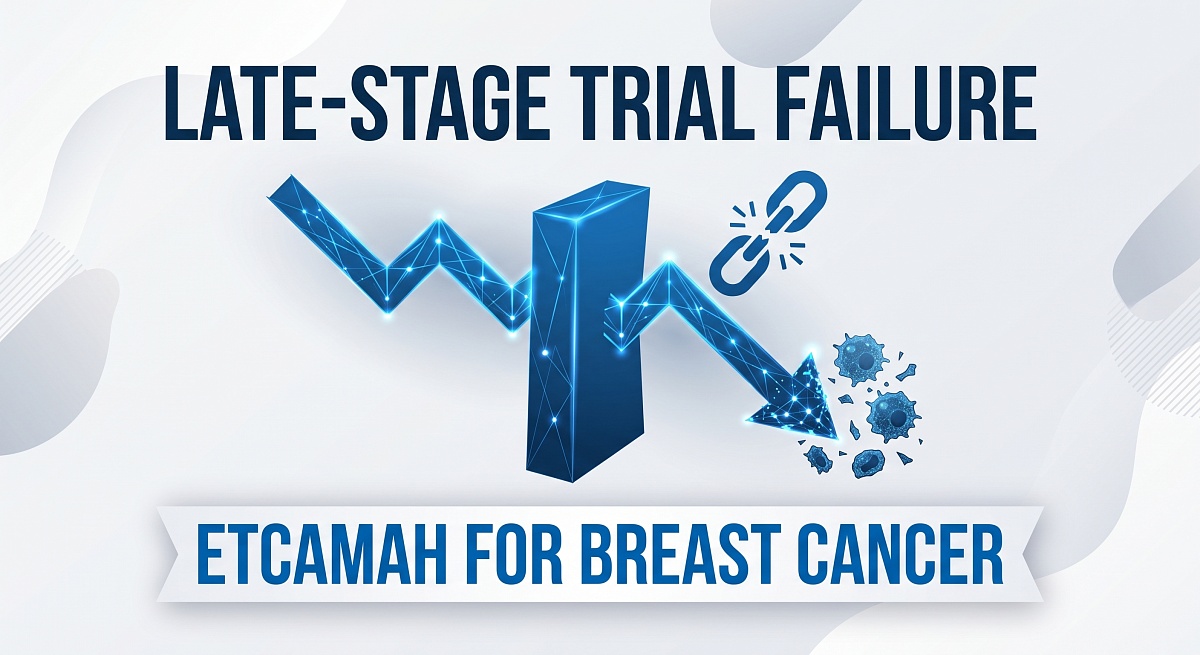
Just days after receiving FDA accelerated approval, AstraZeneca's oral breast cancer drug Etcamah failed to show progression-free survival improvement in the Phase 3 SERENA-4 trial.
SERENA-4 was assessing AstraZeneca’s Etcamah (Camizestrant, AZD9833) as a first-line option for certain patients with advanced breast cancer—a setting that could have meant a $2.9 billion opportunity for the drug. Just days after crossing the FDA finish line for a separate indication, AstraZeneca’s oral SERD drug Etcamah failed to show improvement in progression-free survival in a Phase 3 study—potentially pushing a larger opportunity out of reach.
In the Phase 3 SERENA-4 study, Etcamah was being tested in combination with Pfizer’s CDK4/6 blocker Ibrance as a frontline treatment for patients with ER+, HER2- advanced breast cancer. Comparators were given Ibrance plus the aromatase inhibitor anastrozole. While investigators observed a numerical improvement in the trial’s primary endpoint of progression-free survival (PFS), the result was statistically significant, according to a Friday announcement.
Leerink analysts had been looking forward to SERENA-4, writing in a Sept. 5 note that a positive outcome could open “a significantly larger opportunity” for Etcamah. The firm doubled down on this assessment in a Sept. 12 note issued after the study’s failure, though analysts conceded it had always been a long shot.
“While the 1L SERENA-4 trial constituted a larger opportunity, it was also high-risk, high-reward,” Leerink said, noting that the firm had attributed only a 20% chance of success to the study. The analysts project peak Etcamah sales to hit $830 million, down from their previous unadjusted $2.9 billion estimate had SERENA-4 succeeded.
AstraZeneca continues to advance Etcamah in a comprehensive development program in early breast cancer. This includes CAMBRIA-1 and CAMBRIA-2, Phase 3 trials that span around 10,000 patients who are at intermediate and high risk of recurrence, the pharma said on Friday. CAMBRIA-1 is expected to read out in the first half of 2027, according to Leerink.
SERENA-4’s failure comes just days after the FDA granted accelerated approval to Etcamah’s use in patients with HR+/HER2- breast cancer who also carry ESR1 mutations, as detected during aromatase inhibitor and CDK4/6 inhibitor therapy. Etcamah is indicated to be used with a CDK4/6 inhibitor like Pfizer’s Ibrance, Eli Lilly’s Verzenio or Novartis’ Kisqali.
The FDA approved Etcamah based on the Phase 3 SERENA-6 study, which documented a significant 56% decrease in the risk of disease progression or death—the trial’s primary endpoint—versus controls on standard of care. The FDA’s verdict marked a key victory for AstraZeneca after an advisory committee in April voted 6-3 against an approval due to issues with the study design. Still, with only SERENA-6’s data in its label, Etcamah will likely achieve only “modest revenues,” Leerink said in its Sept. 5 note.