




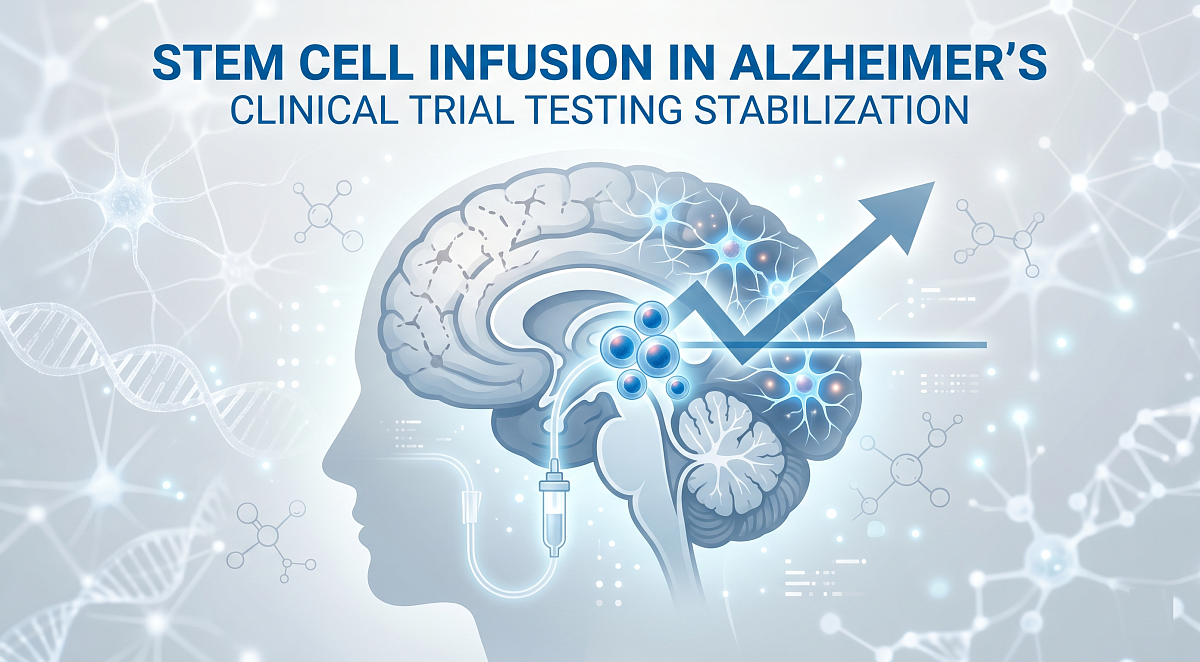
A new clinical trial is evaluating whether a single mesenchymal stem cell infusion can stabilize cognitive decline in patients with mild cognitive impairment or early Alzheimer’s disease
A new investigator-initiated clinical trial at the University of Miami Miller School of Medicine is exploring whether a single infusion of mesenchymal stem cells can stabilize cognitive decline in patients with mild cognitive impairment or early Alzheimer’s disease.The trial, led by Barry Baumel, an associate professor of neurology and director of memory disorders clinical trials at the University of Miami Miller School of Medicine, builds on both emerging standard-of-care therapies and earlier stem cell research in which Baumel participated, including a published phase I clinical trial investigating Lomecel-B, a mesenchymal stem cell – based therapy.
“What I want to see, in this group that’s being treated to slow their disease, is if we can stabilize so it stops getting worse,” Baumel said.
Combining stem cell therapy with standard treatments
The current study targets patients already receiving anti-amyloid monoclonal antibody therapies (Leqembi or Kisunla) that are widely used in early Alzheimer’s disease.These drugs remove amyloid plaque and slow disease progression but do not halt or reverse it.“We have data that shows us how people do on these drugs,” Baumel said.“It’s like a ski slope. Over time, the slope changes. It’s still a ski slope, but it’s not as steep a ski slope, if you take the medications. You end up going down the hill slower.”
The trial adds a one-time intravenous infusion of human mesenchymal stem cells (hMSCs) to see if they can further improve outcomes.Participants will be monitored longitudinally following the stem cell infusion, with outcomes focused on whether cognitive decline stabilizes or improves.The study intentionally delays the stem cell treatment until patients have already been on monoclonal antibody therapy for six months, minimizing confounding safety signals from overlapping treatments.
How stem cells may reduce brain inflammation
The study is grounded in a growing understanding that Alzheimer’s disease involves more than amyloid accumulation alone.Neuroinflammation is increasingly recognized as a key driver of disease progression.“There’s a lot of brain inflammation in people with Alzheimer’s disease,” Baumel said.“We know removing the amyloid reduces inflammation, and that may be why it slows the progression.”
Mesenchymal stem cells may offer a complementary approach because of their immunomodulatory and regenerative properties.They can migrate to sites of injury, release anti-inflammatory molecules and promote tissue repair.“Stem cells are also very potent anti-inflammatories,” Baumel said. “So that may add to the anti-inflammatory effect of removing the amyloid. Our theory is that adding another anti-inflammatory medication, a potent one like stem cells, can really be helpful.”This dual mechanism of reducing amyloid burden and modulating inflammation underpins the trial’s hypothesis.
Building on early clinical evidence
Baumel’s current work is informed by a previously published phase I clinical trial, co-authored by him, that evaluated Lomecel-B in patients with mild Alzheimer’s disease.In that study, patients received a single, intravenous infusion of stem cells or placebo in a randomized, double-blind design.The trial’s endpoint was safety, and that was successfully met, with no treatment-related serious adverse events.
Exploratory findings suggested potential clinical benefit. Patients receiving lower-dose stem cell infusions showed improved or stabilized cognitive performance compared to placebo, along with favorable changes in biomarkers related to inflammation and vascular function.Fluid-based and imaging outcomes also indicated that stem cell therapy may influence multiple aspects of Alzheimer’s pathology, including neuroinflammation and neurovascular health.The current trial expands those findings by combining stem cell therapy with standard anti-amyloid treatment.