



FDA approves daily pill shown to cut repeat stroke risk by 26%
Click to view quick news summary (Spoiler)
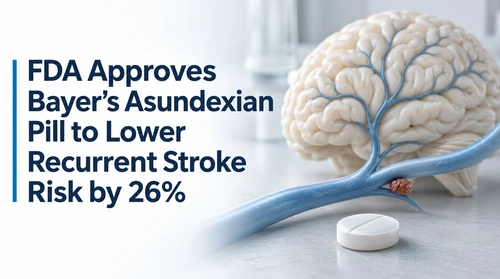
The FDA approved Sunharbo (asundexian) for secondary stroke prevention in certain adults after trial data showed a 26% reduction in relative ischemic stroke risk.
The Food and Drug Administration has approved Sunharbo (asundexian) to help prevent another stroke in certain adults. Patients take one 50-milligram pill daily alongside standard antiplatelet treatment, such as aspirin, to help prevent blood clots.
According to the FDA release, the medication is intended for adults who recently experienced an ischemic stroke caused by a clot that did not originate in the heart, or a transient ischemic attack. Often called a mini-stroke, a TIA occurs when blood flow to the brain is temporarily interrupted.
Sunharbo is the first approved medication of its kind to inhibit factor XIa, a blood protein involved in clot formation. What they're saying: "This blocks a very specific protein that’s part of the cascade of blood clotting," Dr. Richard Kovacs, a cardiologist at Indiana University School of Medicine and chief medical officer of the American College of Cardiology, told Fox News Digital.
The backstory: The approval was based on a phase 3 randomized trial of 12,327 patients in 37 countries. All participants had recently experienced a non-cardioembolic ischemic stroke or a high-risk TIA.
Over approximately 14.2 months, patients who received 50 milligrams of asundexian daily alongside antiplatelet therapy had a 26% lower relative risk of ischemic stroke than those given a placebo with antiplatelet therapy. Major bleeding did not increase significantly overall, though researchers identified higher risks in some groups. Gastrointestinal bleeding occurred more frequently among patients taking asundexian, and patients older than 75 had an increased risk of major bleeding during the first 90 days.
About 6.6% of patients receiving asundexian had a stroke, compared with 8.8% of those receiving a placebo. "So it doesn’t completely eliminate the risk of a second stroke," Kovacs said. The combined rate of death from heart-related causes, heart attack or stroke was also lower in the asundexian group, at 9.2%, compared with 11.1% in the placebo group. Deaths from any cause occurred in 10.5% of patients taking the medication and 12.3% of those taking a placebo.
The findings appeared in The New England Journal of Medicine on Nov. 9.
Bayer, which manufactures asundexian, funded the trial. Researchers acknowledged several limitations, including a treatment period averaging about 14 months that leaves questions about the drug’s long-term safety and effectiveness.
By the numbers: More than 795,000 people experience a stroke in the United States annually, including approximately 185,000 who have had a previous stroke, according to the Centers for Disease Control and Prevention. About one in four stroke survivors has another stroke within five years.