



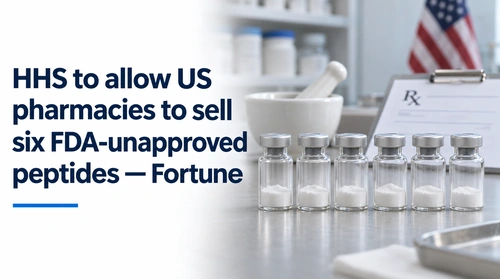
HHS to allow pharmacies to sell six FDA-unapproved peptides — Fortune
Click to view quick news summary (Spoiler)
An HHS policy is expected to permit compounding pharmacies to sell six peptides that lack FDA approval and proven safety or effectiveness.
In the United States, a Department of Health and Human Services (HHS) policy dated October 29, 2026, is expected to expand access to six peptides by allowing compounding pharmacies to produce and sell them. These are BPC-157, Epitalon, KPV, MOTS-c, Semax, and TB-500 — substances that are not approved by the U.S. Food and Drug Administration (FDA) and whose safety and effectiveness have not been proven.
Fortune reports this. Previously, consumers purchased such peptides mainly online or in wellness stores. Until 2023, some of them were also sold through compounding pharmacies, but that year the FDA barred such pharmacies from producing and selling a number of peptides because of unspecified significant safety concerns.
Committee vote
In July 2026, an advisory committee voted 8 to 6 in favor of expanding access to the six peptides. Before the vote, FDA scientists repeatedly told the committee that the available information on the safety and effectiveness of these substances was insufficient to allow pharmacies to produce them.
U.S. Health and Human Services Secretary Robert F. Kennedy Jr. had previously called on the FDA to review the 2023 restrictions. He also appointed eight new members to the committee that advises the FDA on this issue; according to the report, all of them were affiliated with companies that sell or promote peptides.
How the policy will work
The policy provides for the use of a mechanism under which the regulator decides not to take enforcement action. In this case, pharmacies are notified that they will face no legal consequences for producing and selling the six listed peptides.
Such pharmacies may prepare prescription medicines for patients for whom commercially available drugs in an approved form or dosage are unsuitable. The author of the report, Villanova University law professor Ana Santos Rutschman, warns that pharmacies are not required to test ingredients obtained from outside suppliers. In her assessment, an increase in the number of sales outlets will not mean the emergence of regulatory verification of the safety and effectiveness of these products.
Some influencers call the combination of BPC-157 and TB-500 the Wolverine stack and promote it for building muscle mass and recovery after workouts.
The Six Affected Peptides
- BPC-157 (often marketed for ulcerative colitis or tissue healing)
- TB-500 (marketed for wound healing)
- Epitalon (marketed for insomnia/anti-aging)
- Semax (marketed for migraine and cognitive/cerebral support)
- KPV (marketed for wound healing and inflammation)
- MOTS-c (marketed for metabolic health and obesity)