



FDA Approves Vepdegestrant for ESR1-Mutant Advanced Breast Cancer
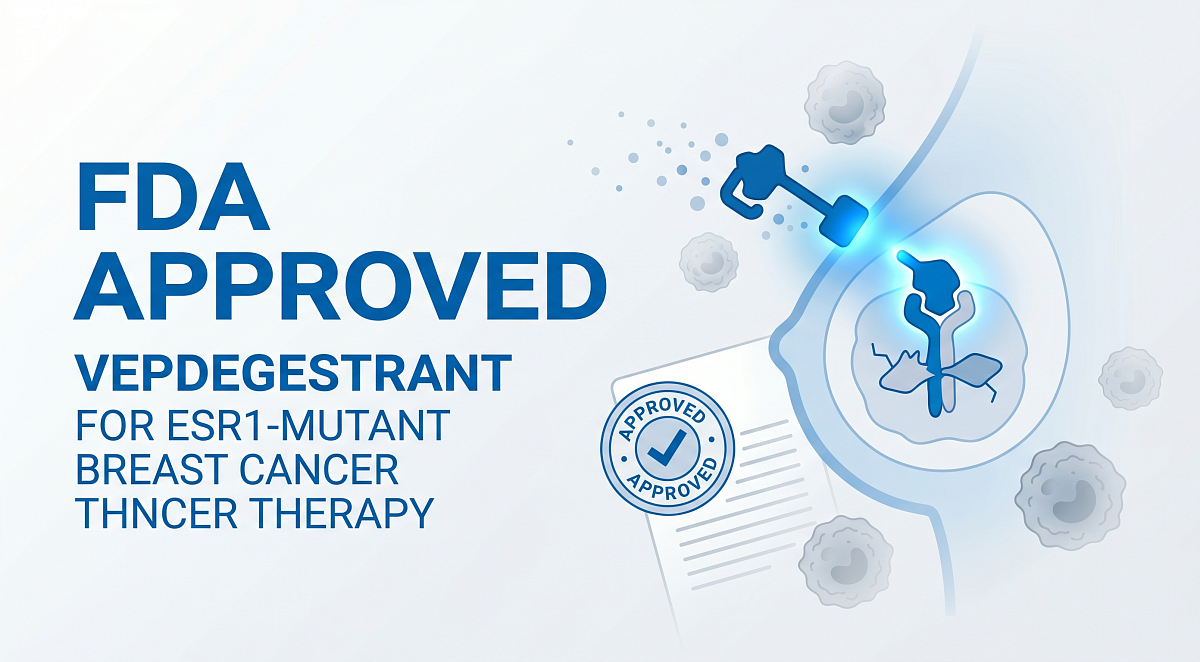
Five months versus 2.1 months. That progression-free survival gap — a 43% reduction in risk of disease progression or death compared to fulvestrant — is the number that earned VEPPANU (vepdegestrant, developmental code name — ARV-471) its FDA approval on May 1, more than a month ahead of the June 5 PDUFA date. The margin is not subtle, and the comparator is not a straw man: fulvestrant has been standard of care in ESR1-mutated, ER+/HER2- advanced breast cancer for years precisely because nothing convincingly beat it in this population.
Clinical Significance of VERITAC-2
What makes the VERITAC-2 result clinically significant is the baseline it was drawn against. Up to 40–50% of patients who progress on frontline endocrine therapy plus a CDK4/6 inhibitor carry ESR1 mutations, and those patients historically face rapid deterioration with thin second-line options. The 270-patient ESR1-mutant subgroup drove the approval, and the hazard ratio of 0.57 (95% CI: 0.42–0.77, p=0.0001) holds up under scrutiny. Overall survival data are immature — only 16% of deaths had occurred at the time of the PFS analysis — so the magnitude of the survival benefit remains an open question, but the PFS signal was clean enough for the FDA to act decisively.
A First-in-Class Mechanistic Milestone
The regulatory milestone is inseparable from a mechanistic one: vepdegestrant is the first approved PROTAC, a proteolysis-targeting chimera that degrades the estrogen receptor protein rather than simply blocking it. That distinction matters clinically because degradation eliminates the receptor entirely, removing a resistance mechanism that partial antagonists like fulvestrant leave intact. The safety profile from VERITAC-2 was manageable — most adverse events were Grade 1–2, with hematologic and liver enzyme abnormalities the most common findings — though the QTc prolongation signal in the label will require routine monitoring in practice.
The commercial picture is unresolved. Arvinas and Pfizer are still selecting a third-party commercialization partner, which introduces real execution risk in a competitive breast cancer market where oncologists will be weighing vepdegestrant against elacestrant, the only other approved option specifically targeting ESR1-mutant disease. The one number to watch as commercial launch unfolds: real-world time-to-progression in patients who received prior CDK4/6 inhibitor therapy, since that subgroup’s outcomes within VERITAC-2 will determine whether the PFS benefit translates outside the trial’s controlled enrollment criteria.