



FDA issues warning letter to ImmunityBio over misleading promotion of NAI
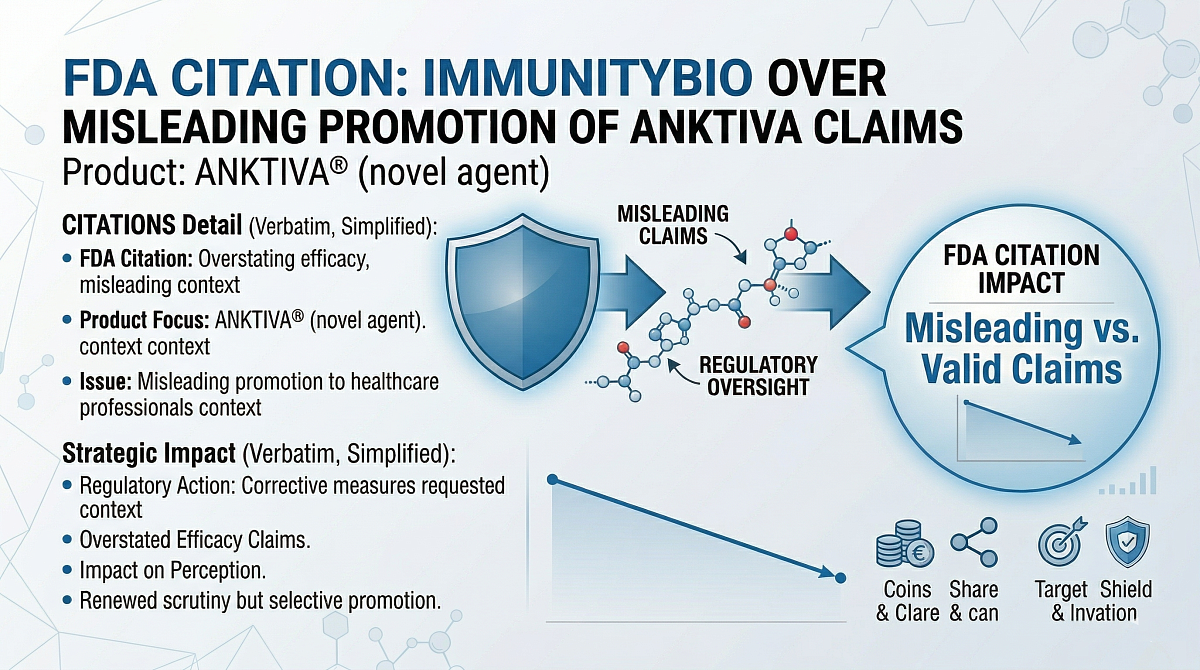
The FDA has issued a warning letter to ImmunityBio, citing false or misleading promotional communications related to nogapendekin alfa inbakicept-pmln (NAI; Anktiva), an intravesical immunotherapy approved for select patients with non–muscle invasive bladder cancer.
The agency said promotional materials for Anktiva overstated efficacy, omitted risk information and suggested unapproved uses, raising concerns about patient safety and regulatory compliance.
Date: April 8, 2026
Key facts
- The FDA issued a warning letter to ImmunityBio over promotional communications about NAI (Anktiva).
- The agency said materials overstated efficacy, omitted risk information, and suggested unapproved uses.
- The cited materials included a direct-to-consumer television advertisement and a podcast featuring founder and executive chairman Patrick Soon-Shiong, MD.
- The FDA said Anktiva is approved only for a specific type of non–muscle invasive bladder cancer, not for broad cancer treatment claims.
The FDA has issued a warning letter to ImmunityBio citing false or misleading promotional communications related to nogapendekin alfa inbakicept-pmln (NAI; Anktiva), an intravesical immunotherapy approved for select patients with non–muscle invasive bladder cancer (NMIBC).
The agency determined that both a direct-to-consumer television advertisement and a podcast with founder and executive chairman Patrick Soon-Shiong, MD, overstated efficacy, omitted risk information, and suggested unapproved uses, raising concerns about patient safety and regulatory compliance.
The FDA’s Office of Prescription Drug Promotion concluded that the materials misbranded the drug under the Federal Food, Drug, and Cosmetic Act by implying that Anktiva could cure or prevent cancer broadly, despite its only approved indication being for a specific type of NMIBC. The agency emphasized that such claims are especially concerning in oncology, where patients may be particularly vulnerable to exaggerated therapeutic expectations.
FDA says Anktiva promotion went beyond the approved indication
NAI received FDA approval in 2024 for use in combination with BCG for adult patients with BCG-unresponsive NMIBC with carcinoma in situ, with or without papillary tumors. The approval was based on findings from the phase 2/3 QUILT-3.032 trial, a single-arm, multicenter study evaluating intravesical NAI plus BCG.
In that study, 77 patients with BCG-unresponsive high-risk NMIBC with carcinoma in situ with or without Ta/T1 papillary disease achieved a complete response rate of 62%, with a 95% confidence interval of 51 to 73. Among responders, 58% maintained response for at least 12 months, and 40% for at least 24 months.
However, the single-arm design limits interpretation of time-to-event endpoints such as disease-free survival because no comparator arm was included. The FDA warning letter reiterates this limitation, noting that claims suggesting durable cure or prevention are not supported by the available data. Additionally, a separate cohort evaluating Anktiva monotherapy in this setting was discontinued early due to futility. As such, the FDA noted that it is not aware of data that would support efficacy of NAI alone for NMIBC.
Agency outlined multiple categories of promotional violations
According to the FDA, the promotional materials included several categories of violations. These included overstated efficacy, with statements implying that Anktiva could cure cancer or prevent recurrence across all patients despite the absence of supporting clinical evidence.
The agency also cited unapproved indications, saying the materials suggested efficacy in all cancers, including lung cancer and post–checkpoint inhibitor settings, which fall outside the drug’s approved use. In addition, the communications described the drug as a single jab or subcutaneous injection, even though it is approved exclusively for intravesical administration.
The FDA further objected to references to Anktiva as a cancer vaccine, stating that this was an inaccurate characterization of mechanism. The agency noted that the product is an IL-15 receptor agonist that stimulates natural killer cells, CD8-positive cells, and memory T-cell activity. It also said the podcast reportedly contained no safety disclosures and that the television advertisement minimized risk presentation relative to benefit claims.
Beyond the content itself, the FDA cited procedural violations as well, including the failure to submit the podcast under Form FDA 2253 at the time of initial publication or dissemination.
The FDA said claims implying that Anktiva could broadly cure or prevent cancer were not supported by the available evidence and were especially concerning in oncology settings.
ImmunityBio says it has responded and launched corrective actions
In a public statement, ImmunityBio reported that it has submitted a formal response to the FDA and initiated corrective actions. The company stated that the cited podcast has been removed from its website and that it has requested removal from third-party platforms. Additionally, the company indicated that the television advertisement referenced in the warning letter was never broadcast.
ImmunityBio also described implementation of enhanced Promotional Review Committee processes, executive training, and external regulatory oversight to improve compliance. The company said it is working with its legal and regulatory teams to complete a comprehensive review of all promotional materials and external communications claims.
The company characterized the statements made in the podcast as aspirational and forward-looking commentary on its broader immunotherapy platform rather than promotional claims tied to the approved indication. Even so, the FDA warning letter makes clear that the agency believes the materials crossed the line into misleading promotion by overstating benefit, minimizing risk, and extending claims beyond the approved use of Anktiva.
The warning letter therefore represents both a regulatory setback and a compliance test for ImmunityBio. In oncology, where promotional language can strongly influence patient expectations and treatment perceptions, the FDA’s action underscores how closely the agency monitors claims around efficacy, administration, safety, and approved indications, especially when those claims appear in consumer-facing media and executive commentary.