



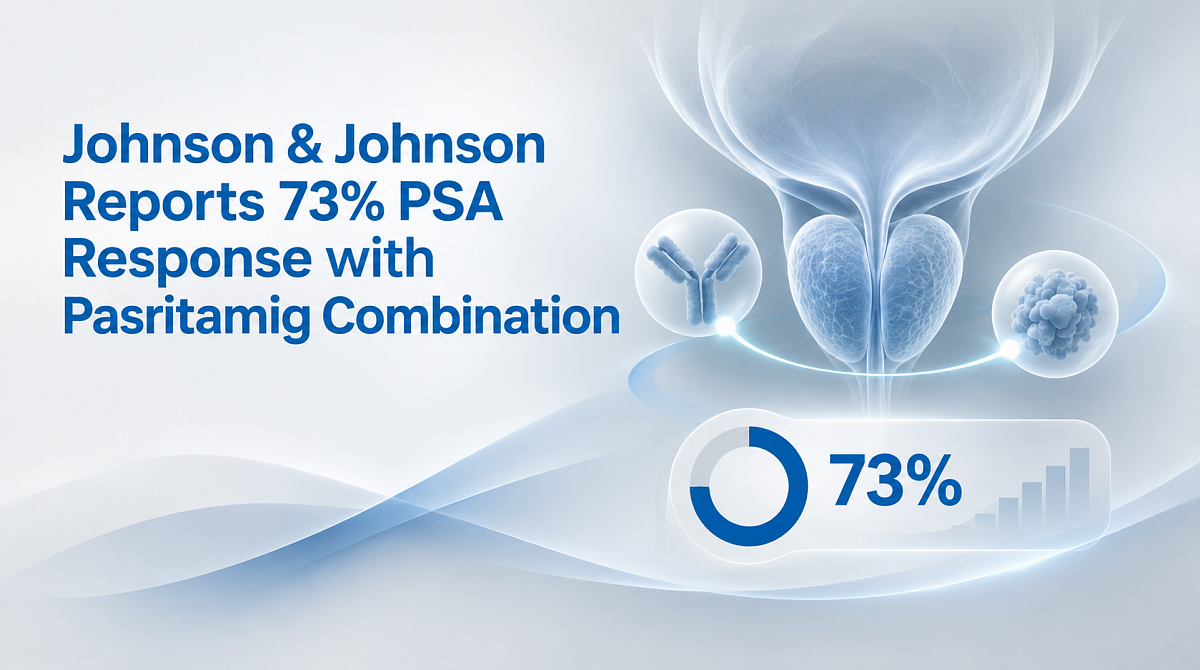
Johnson & Johnson reports 73% PSA response rate with investigational pasritamig-based immunotherapy combination in advanced prostate cancer
Click to view quick news summary (Spoiler)
In early Phase 1 results, 11 of 15 patients had PSA reductions of at least 50% with the pasritamig and JNJ-9401 combination.
NEW BRUNSWICK, N.J. -- Johnson & Johnson today announced promising first-in-human Phase 1 results for the investigational combination of pasritamig and JNJ-9401, two bispecific antibodies designed to work together to drive the body's immune response against advanced prostate cancer. At the recommended regimen, 73 percent (11 of 15 patients) achieved reductions of at least 50 percent in prostate-specific antigen (PSA), a marker used to monitor prostate cancer activity, including 47 percent (7 of 15 patients) who achieved reductions of at least 90 percent. Results were presented in a late-breaking oral session at the Society for Immunotherapy of Cancer (SITC) 2026 Annual Meeting (Abstract #1175).
The combination represents the first dual-tumor-antigen-targeted bispecific antibody regimen clinically evaluated in prostate cancer, targeting kallikrein-related peptidase 2 (KLK2) and prostate-specific membrane antigen (PSMA) through complementary T-cell signals designed to activate and enhance the function of immune cells against cancer. In the study, deep and sustained PSA responses were observed, with all seven patients who achieved reductions of at least 90 percent remaining on treatment for more than six months without disease progression. No Grade 3 or higher treatment-related adverse events were reported in this early analysis.
A first-of-its-kind approach: targeting two prostate cancer proteins with complementary T-cell signals
For patients with metastatic castration-resistant prostate cancer (mCRPC), treatment remains challenging as the disease progresses and available options become more limited. Median overall survival is approximately two to three years, highlighting the need for continued innovation. While immunotherapies have transformed the treatment of some cancers, their role in prostate cancer has historically been limited, and immune checkpoint inhibitors have shown minimal clinical benefit.
Bispecific antibodies are designed to help the immune system recognize and attack cancer by activating T cells, a process that can be enhanced by generating two complementary signals. Pasritamig, a first-in-class, bispecific antibody targeting KLK2 has demonstrated single-agent antitumor activity, and is designed to provide the first signal by directing T cells toward prostate cancer cells. JNJ-9401, a novel bispecific antibody targeting PSMA, provides a second signal designed to strengthen and sustain T cell activity.
Expert and company perspectives on the potential of this dual-antigen targeted bispecific regimen
"Prostate cancer has long been difficult to treat with immunotherapy, which makes the activity we're seeing particularly interesting," said Laura Graham, M.D., Assistant Professor of Medicine-Medical Oncology at the University of Colorado School of Medicine. "By combining two complementary approaches to T-cell activation, we are exploring a new way to engage the immune system against this disease. The depth of PSA reductions observed in this study, including responses sustained for six months or longer, provides encouraging early evidence for the pasritamig-JNJ-9401 combination that warrants further investigation in a larger Phase 3 study."
"This novel dual-antigen-targeted bispecific regimen combines pasritamig, a foundational component of our prostate cancer pipeline, with JNJ-9401, highlighting the potential of complementary mechanisms working together," said Yusri Elsayed, M.D., M.H.Sc., Ph.D., Global Therapeutic Area Head, Oncology, Johnson & Johnson. "With this combination now in Phase 3 development, we are building on the early promise of this approach as we work to bring new treatment options to patients with advanced disease."