




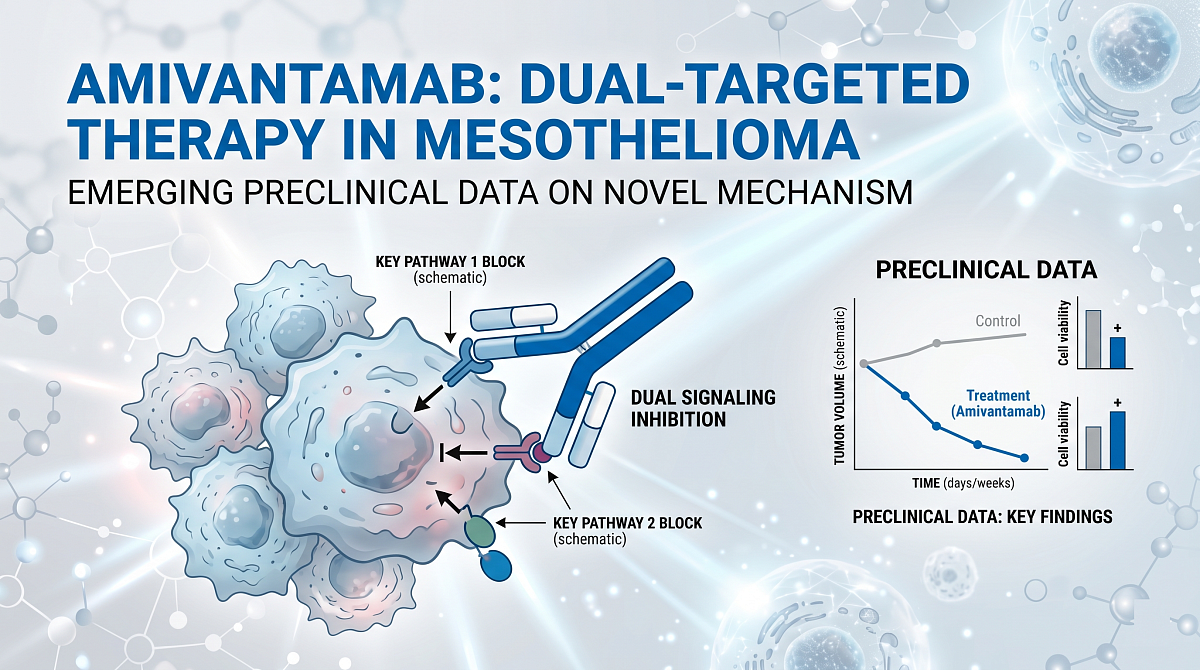
Amivantamab Shows Preclinical Immune-Mediated Activity in Mesothelioma Through Dual EGFR and MET Targeting
Click here to view quick news summary (Spoiler)
Preclinical data published in the Journal of Thoracic Oncology reveals that the bispecific antibody amivantamab successfully co-targets EGFR and MET expressions in diffuse pleural mesothelioma cells, inducing natural killer cell-mediated cytotoxicity to significantly lower tumor progression.
Diffuse pleural mesothelioma remains one of the most difficult thoracic malignancies to treat. Despite advances in systemic therapy, there are still limited options designed to directly target tumor-cell vulnerabilities in this disease. A new preclinical study published in the Journal of Thoracic Oncology explores whether amivantamab, a bispecific antibody targeting both EGFR and MET, could offer a new therapeutic approach for mesothelioma.
The study found that EGFR and MET are frequently co-expressed in diffuse pleural mesothelioma cells. Amivantamab bound preferentially to mesothelioma cells, inhibited EGFR and MET signaling, promoted receptor internalization, and induced natural killer cell-mediated antibody-dependent cellular cytotoxicity. In patient-derived xenograft models, amivantamab combined with human natural killer cells significantly reduced tumor growth without overt toxicity. These findings remain preclinical, but they provide a rationale for clinical investigation of dual EGFR/MET targeting in mesothelioma.
Why EGFR and MET Matter in Mesothelioma
Diffuse pleural mesothelioma is an aggressive malignancy arising from the pleural lining of the lung. The disease is biologically complex and often difficult to treat, particularly after progression on first-line systemic therapy. Although immunotherapy and chemotherapy have improved outcomes for some patients, treatment resistance remains common. EGFR and MET are receptor tyrosine kinases involved in cellular proliferation, survival, migration, and treatment resistance across several cancer types. Previous studies have suggested that both receptors are frequently expressed in mesothelioma. However, the therapeutic relevance of co-targeting EGFR and MET in this disease has remained uncertain.
Amivantamab, sold under the brand name Rybrevant, is a bispecific monoclonal antibody used to treat non-small cell lung cancer. Amivantamab is a bispecific epidermal growth factor (EGF) receptor-directed and MET receptor-directed antibody. It is the first treatment for adults with non-small cell lung cancer whose tumors have specific types of genetic mutations: epidermal growth factor receptor (EGFR) exon 20 insertion mutations. Amivantamab is a bispecific antibody designed to bind both EGFR and MET. It has established clinical activity in selected settings of non–small cell lung cancer, but its role in mesothelioma has not yet been defined.