



An international research group has examined how many people are affected by preclinical and clinical obesity and what health risks are associated with this. The team led by Prof. Matthias Schulze from the German Institute of Human Nutrition Potsdam-Rehbruecke (DIfE) discovered that almost all people with obesity, i.e., a body mass index (BMI) of at least 30 kg/m², exhibit other measurable indications of increased body fat mass and that around 80% of affected individuals are already experiencing health-related complications. The results have been published in the journal Nature Communications.
New definition of obesity
The World Health Organization (WHO) has long classified obesity as a disease. Nevertheless, it is disputed whether obesity is truly an independent disease or rather a risk factor for other diseases. In early 2025, an international commission launched by The Lancet Diabetes & Endocrinology proposed classifying obesity into two categories: Preclinical and clinical obesity. According to this concept, obesity should be confirmed by at least one other anthropometric criterion, such as waist circumference or body fat content, in addition to BMI.
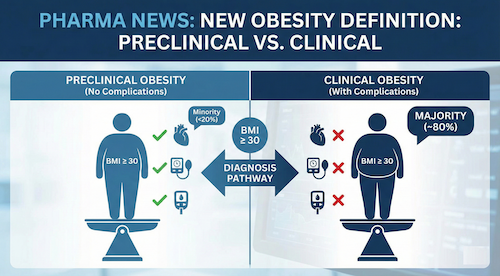
Furthermore, people with diagnosed obesity who also show obesity-related abnormalities, such as high blood pressure or disorders of glucose and lipid metabolism, should be classified as having clinical obesity, and people without these abnormalities as having preclinical obesity. The commission proposes classifying clinical obesity as an independent disease with corresponding treatment indications.
Evaluation of large population and interventional studies
Against this backdrop, scientists from the German Center for Diabetes Research (DZD), DIfE, and the University Hospital Tübingen have explored how frequently preclinical and clinical obesity occur in the population, whether affected individuals have an increased risk of type 2 diabetes and cardiovascular disease, and whether a lifestyle intervention can reduce the prevalence of clinical obesity.
To do so, the researchers evaluated the data from three major studies: The National Health and Nutrition Examination Survey (NHANES; representative of the U.S. population), the European Prospective Investigation into Cancer and Nutrition (EPIC) Potsdam Study, and the Tuebingen Lifestyle Intervention Program (TULIP).
Differences in risk: Preclinical versus clinical obesity
In the process, it was demonstrated that 100% of people with a BMI equal to or greater than 30 kg/m² could be confirmed as having obesity based on at least one other anthropometric criterion. Furthermore, around 80% met the criteria for clinical obesity.
Risk Assessment: People with clinical obesity had an approximately 3-times higher risk of cardiovascular disease and a roughly 8-times higher risk of type 2 diabetes compared with people who do not have obesity and do not meet the clinical criteria. In contrast, people with preclinical obesity did not exhibit an increased risk of cardiovascular disease but still had an increased risk of type 2 diabetes.
A nine-month lifestyle intervention in the TULIP study lowered the rate of clinical obesity from 71% to 57% and the rate of prediabetes from 52% to 29%. The scientists determined that blood pressure, triglyceride levels, and blood sugar regulation were particularly improved by the intervention.
Furthermore, less than 20% of people with confirmed obesity would be considered preclinical. Most people with obesity already exhibit measurable health impairments and are therefore classified as having clinical obesity.
In further studies, the researchers want to compare the new criteria with already established concepts such as "metabolically healthy" versus "metabolically unhealthy" obesity.