




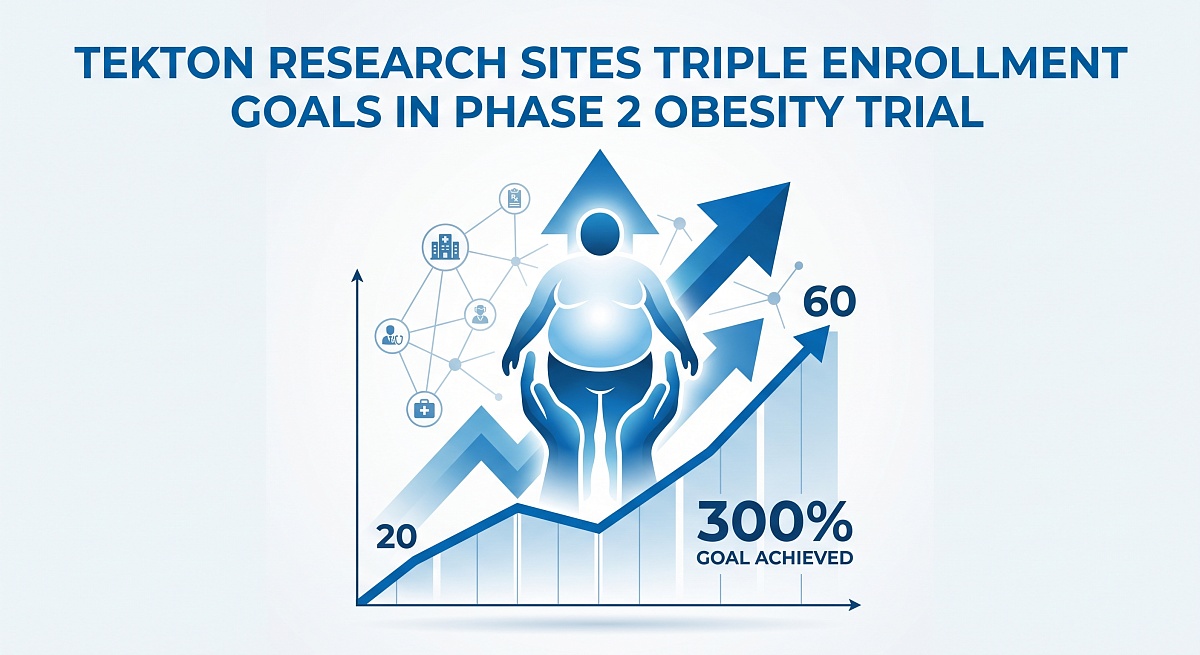
Tekton Research Sites Enroll 60 Participants in Phase 2 Obesity Trial, Triple Goal
Click to view quick news summary (Spoiler)
Tekton Research successfully randomized 60 participants in a Phase 2 obesity trial across two sites, tripling their original enrollment goal and showcasing strong patient access.
Enrolling three times the planned number of participants is rare enough that it usually points to something structural, not just enthusiasm. Tekton Research’s San Antonio and Edmond sites together randomized 60 participants into a Phase 2 obesity trial against a combined target of 20, with both sites clearing their individual goals as well.
The result matters in context. Zepbound’s approval in late 2023 and the earlier Wegovy approval in 2021 accelerated sponsor interest in obesity mechanisms, and the pipeline behind those drugs has produced a wave of early-phase trials competing for the same patient pool. Sites that can reliably identify and screen motivated obesity patients are a genuine bottleneck, and 300% of goal in a Phase 2 suggests Tekton’s San Antonio and Edmond practices have that patient access built in, likely through the primary care and obesity medicine infrastructure those clinics already run. Jara McDonald, an FAAFP and DABOM-certified physician, leads the San Antonio team; Kyle Rickner leads Edmond.
For sponsors weighing site selection on early obesity studies, the operational signal here is straightforward: a site that triples enrollment in Phase 2 can compress dose-finding timelines and give a sponsor cleaner data faster, because the larger-than-planned cohort reduces the chance that a single dropout or protocol deviation distorts a small dataset. That is not a guarantee at Phase 3 scale, and a 20-person target was modest to begin with, but consistent over-enrollment at the Phase 2 stage is exactly the track record sponsors check before awarding larger slots.
The detail worth tracking is whether Tekton converts this result into Phase 3 allocations in obesity. Two sites randomizing 60 where 20 were expected is a data point for a sponsor’s feasibility model; the question is whether it translates into a named-site role in the larger, longer confirmatory work that the current obesity pipeline still needs.