




Bayer’s Heart Failure Drug Bound for NHS on NICE Recommendation
Click to view quick news summary (Spoiler)
The UK's NICE has issued positive draft guidance recommending Bayer's non-steroidal MRA drug Kerendia (finerenone) for NHS patients in England suffering from chronic heart failure with preserved or mildly reduced ejection fraction, offering a new treatment pathway for up to 280,000 eligible individuals.
The UK’s National Institute for Health and Care Excellence (NICE) has officially recommended Bayer’s non-steroidal heart failure drug, Kerendia (finerenone), for routine use within the National Health Service (NHS), addressing a major therapeutic need as cardiovascular conditions remain one of the leading causes of avoidable hospitalizations across England.
Following the UK health watchdog’s debut of its final draft guidance, which the agency expects to formally finalize in August 2026, English adult patients suffering from chronic heart failure (CHF) with preserved or mildly reduced ejection fraction will now be fully eligible for access to this next-generation mineralocorticoid receptor antagonist (MRA).
Mechanism of Action and Clinical Advantages
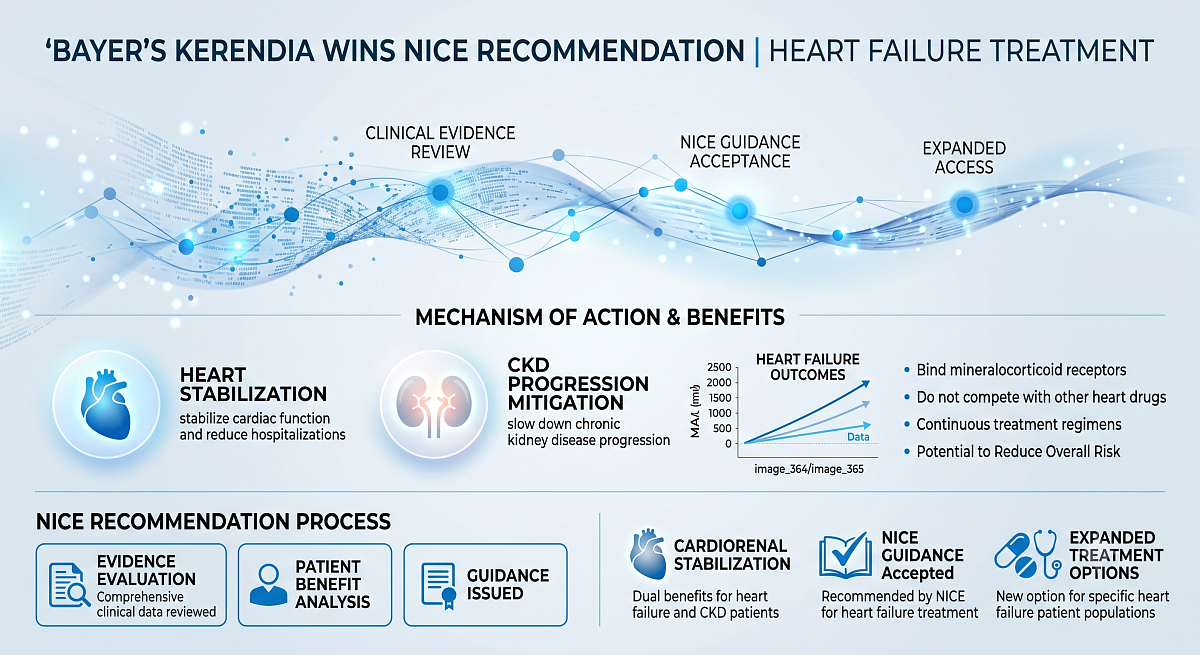
The therapeutic drug acts directly by reducing vascular inflammation and mitigating mineralocorticoid signalling-induced tissue scarring within the muscular layer of the heart wall. Furthermore, Kerendia exhibits its CHF-treating effects by effectively reducing sodium retention in the kidneys, which directly diminishes the strain on the heart when pumping fluid throughout the body.
Unlike traditional MRAs currently available through the NHS — such as Pfizer-developed generic drugs spironolactone and eplerenone — Kerendia holds the clinical potential to treat heart failure across a broader patient population owing to its distinct non-steroidal chemical structure. According to official estimates published by NICE, approximately 280,000 patients across England are expected to be eligible for treatment with Kerendia.
Bayer specifically engineered the small molecule to be far more selective than its pharmacological predecessors, meaning that it is generally associated with a significantly lower rate of adverse sexual side effects linked to the systemic interference in sex hormone activity.
This positive NICE recommendation further expands Kerendia’s overall role within the NHS framework. NICE previously granted approval for its clinical use in adult patients suffering from stage 3 or 4 chronic kidney disease linked to type 2 diabetes back in 2023 — provided patients exhibited persistent presence of the blood protein albumin in their urine.
Addressing Heart Failure Burden in England
Bayer secured this pivotal NICE recommendation as agency statistics reveal that roughly 635,000 patients across England are currently living with diagnosed heart failure, of which nearly half suffer from preserved or mildly reduced ejection fraction.
With over 100,000 hospital admissions directly linked to heart failure complications between 2023 and 2024, the disease represents one of the nation's leading drivers of emergency hospital admissions — underscoring an urgent demand for effective preventative and disease-modifying medical options.
Once distributed to patients in England, Kerendia will complement an established cardiovascular treatment arsenal alongside SGLT2 inhibitors like Boehringer Ingelheim and Eli Lilly’s Jardiance (empagliflozin) and AstraZeneca’s Forxiga (dapagliflozin) — both of which received NICE authorization for CHF with preserved or mildly reduced ejection fraction in 2023 — as well as legacy MRA therapies and loop diuretics used to manage fluid overload.
According to Helen Knight, director of medicines evaluation at NICE, Kerendia not only holds strong potential to improve patient quality of life, but also presents an opportunity to “save the NHS money and free up space” by significantly diminishing the risk of unplanned emergency hospitalizations. This decision aligns with the streamlined regulatory framework introduced in March 2026, when the UK’s Medicines and Healthcare products Regulatory Agency (MHRA) and NICE launched an aligned pathway to expedite innovative medicine approvals.