



Artemisinin resistance is rising in East Africa—leaving anti-malarials at risk of failure
Click to view quick news summary (Spoiler)
A new study reveals a widespread increase in artemisinin resistance across East Africa, warning that the efficacy of first-line combination therapies for malaria may rapidly decline unless new treatments and surveillance strategies are deployed.
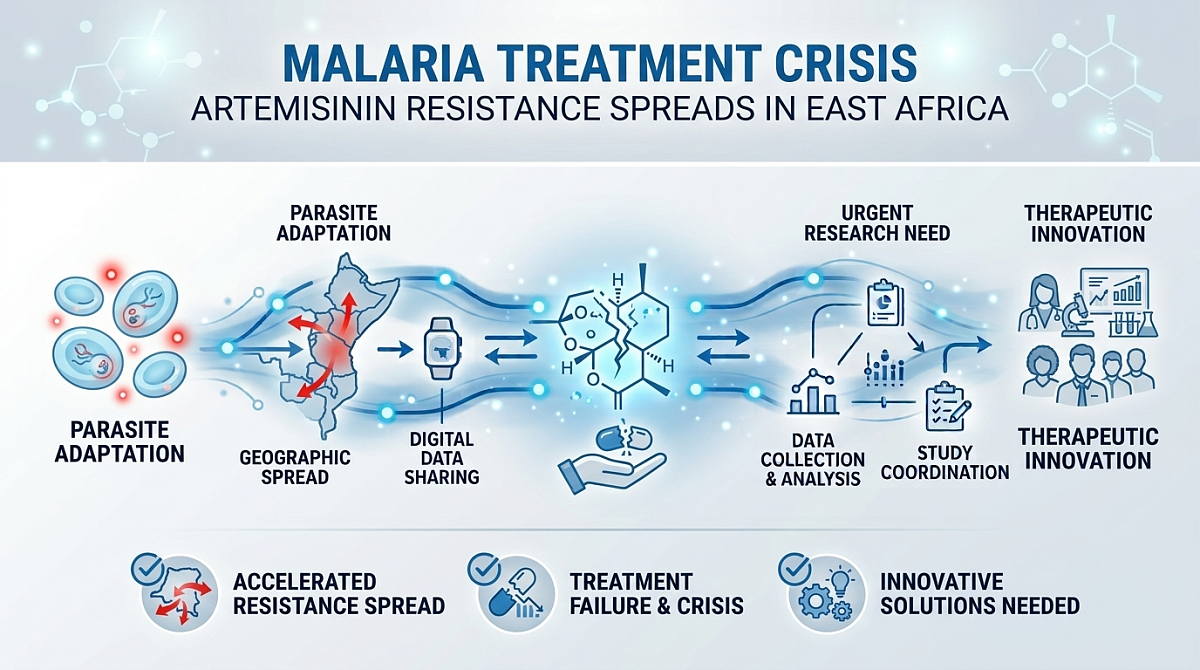
Resistance to the main drug in front-line malaria treatments is becoming significantly more widespread across East Africa, according to new research led by Imperial College London. The comprehensive study, officially published in The Lancet Infectious Diseases, maps the alarming rise in artemisinin resistance in the region and strongly suggests that one of the vital safeguards built into these treatments is currently being eroded. The researchers warn that their findings raise the substantial risk that the effectiveness of current treatments could decline over time if this genetic resistance continues to spread.
Artemisinin is the central, fast-acting core drug in the combination therapies (ACTs) used as first-line malaria treatments worldwide. Studying the parasite that causes the disease (Plasmodium falciparum), researchers found a sharp rise in strains that are highly resistant to it—a critical warning that its power to clear infections may weaken over time. Artemisinin resistance naturally occurs when malaria parasites successfully acquire mutations that blunt the drug's therapeutic effect.
Drawing on an extensive dataset of 185,099 samples collected from published studies across 47 African countries, the researchers produced the very first high-resolution maps illustrating how genetic markers of resistance have expanded across both time and geography in Africa. They found that artemisinin partial resistance is now firmly established across most of Uganda and Rwanda, as well as along the Ethiopia–Eritrea–Sudan border, and is no longer confined to isolated pockets. Strikingly, in Rwanda's Northern Province, the predicted prevalence rose from under 1% in 2012 to a staggering 62% in 2024. Researchers confidently say this pattern mirrors the early warning signs that preceded widespread ACT failure in southeast Asia.
Dr. Robert Verity of Imperial College London, who effectively led the analysis, stated, "Artemisinin-based drugs underpin malaria treatment across sub-Saharan Africa—and our findings are a strict warning that we can't take them for granted. We urgently need new therapies and much smarter ways to deploy existing ones before resistance outpaces us. We also need to critically strengthen molecular surveillance across sub-Saharan Africa, and in neighboring countries where similar signals may emerge. Spotting these genetic markers early gives us a crucial head start, providing time to respond well before they translate into treatment failure."
Dr. Verity added, "Drug resistance is a major challenge and is actively undermining global efforts to control and eliminate the burden of malaria. As with other treatments, like antibiotics, artemisinin-based drugs are essentially a victim of their own massive success, with their widespread global use contributing directly to the rapid rise in drug resistance. Artemisinin-based drugs have been life-changing for millions of people across sub-Saharan Africa—losing these invaluable treatments would be entirely disastrous for public health."