




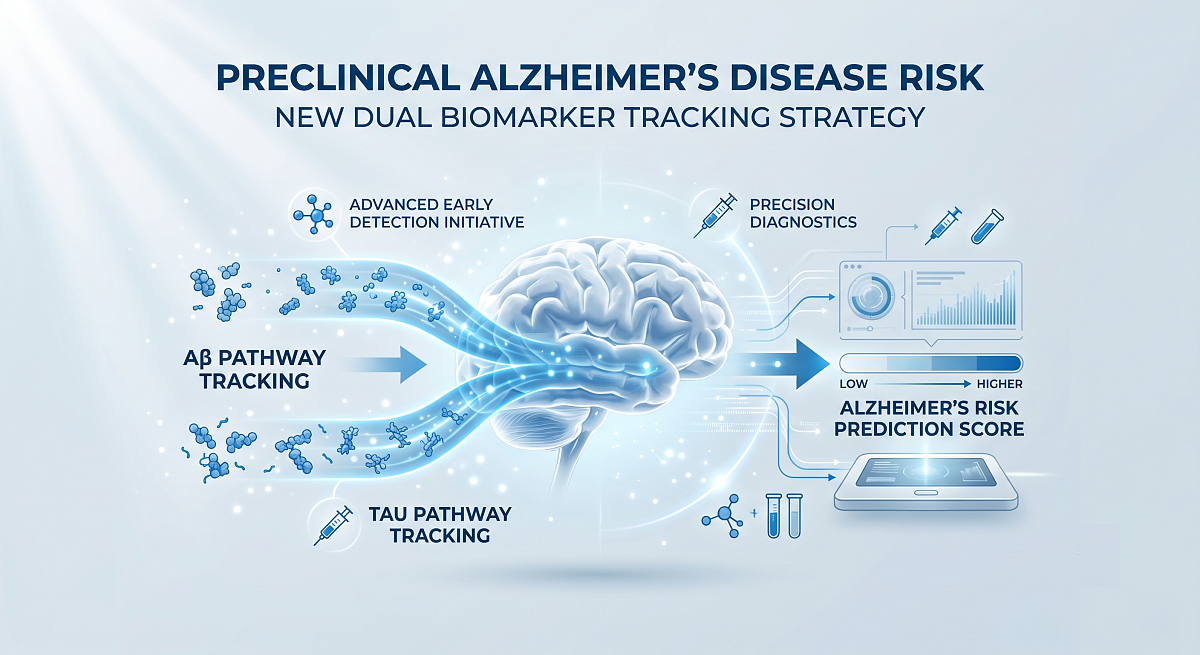
New Biomarker Approach Maps Preclinical Alzheimer’s Disease Risk
Click to view quick news summary (Spoiler)
A comprehensive five-year clinical trial demonstrates that combining plasma p-Tau 217 biomarker data with traditional PET scans significantly improves the prediction of early cognitive decline and structural neurodegeneration in preclinical Alzheimer's disease.
Combined tau biomarkers can now successfully track early cognitive decline and accurately forecast severe structural neurodegeneration specifically within preclinical Alzheimer’s disease. Clinicians actively evaluating completely asymptomatic individuals with confirmed amyloid-beta deposition frequently face highly significant prognostic challenges directly due to highly variable disease trajectories. While advanced plasma biomarkers offer incredibly high diagnostic sensitivity, they often lack the required spatial precision regarding fibrillar protein localization situated within highly specific neural tissues.
To comprehensively address these practical medical limitations, a massive prospective multicenter clinical trial thoroughly evaluated 330 cognitively unimpaired adult participants over an extended five-year continuous tracking period. The ultimate goal was to definitively determine if integrating blood fluid assays directly with standard neuroimaging vastly optimizes accurate patient staging. All participants were successfully confirmed to be amyloid-positive right at the baseline heavily using florbetapir imaging to accurately capture the earliest pathological changes.
Trajectories Across Preclinical Alzheimer’s Disease
The principal investigators carefully stratified the entirely asymptomatic sample utilizing baseline plasma phosphorylated tau-217 levels entirely alongside highly standardized visual evaluations of approved flortaucipir positron emission tomography (PET) scans. Patients clearly presenting with concordant positivity heavily across both diagnostic modalities represented the absolute highest-risk category residing within the classic neurodegenerative cascade.
This specifically positive-concordant subpopulation aggressively exhibited extensive baseline cortical amyloid burden, vastly accelerated fronto-temporo-parietal tau protein dissemination, and severely extreme gray matter volume loss entirely over the follow-up period. Conversely, individuals consistently demonstrating highly discordant biomarker profiles, such as elevated blood markers paired directly with negative visual scans, experienced a much slower biological progression, heavily suggesting either low-tau states or an incredibly early transitional phase of the disease.
Clinical Implications for Healthcare Providers
Longitudinal cognitive assessments meticulously using structured composite scoring tools definitively confirmed that dual-biomarker concordance strongly and directly correlates with severe cognitive decline over valuable time. Comprehensive path mediation analysis brilliantly demonstrated that approximately 52% of the profound relationship existing between progressive tau aggregation and immense memory impairment is directly and physically driven by structural cortical atrophy.
For specialized medical experts, nuclear medicine physicians, and standard primary care providers, these profound findings strongly indicate that standard binary classification is entirely no longer sufficient for properly managing incredibly complex preclinical Alzheimer’s disease cases. Successfully implementing a dual-biomarker strategy securely allows physicians to brilliantly refine early risk prediction, flawlessly identify highly optimal candidates for extensive prevention trials, and strategically implement breakthrough disease-modifying therapies well prior to initial clinical symptom onset. (Reference: Labrador-Espinosa MA et al. Clinico-biological trajectories stratified by combined tau biomarkers in preclinical Alzheimer’s disease. Alzheimer’s Research & Therapy. 2026;18:154).