



Veraxa taps Ardigen AI to identify dual-target combinations for conditional cancer therapies
Click to view quick news summary (Spoiler)
Veraxa Biotech has partnered with AI leader Ardigen to precisely identify dual-target combinations for its BiTAC pipeline, ensuring highly selective cancer treatments that successfully destroy tumors while safely bypassing healthy tissues.
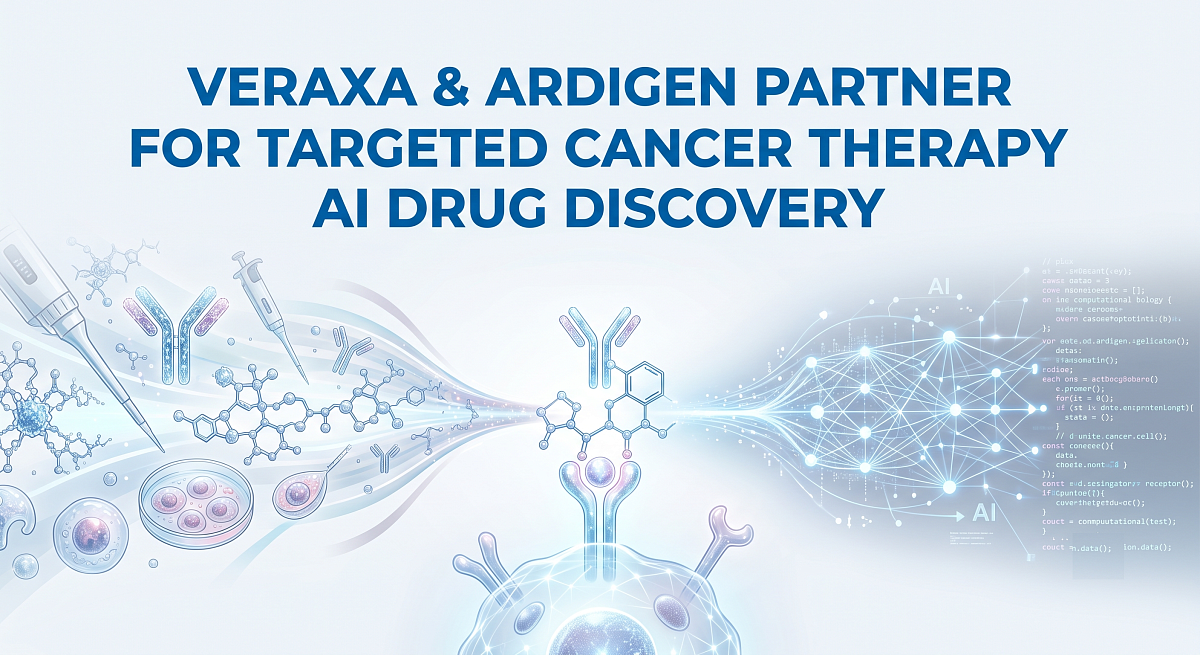
Veraxa Biotech AG and Poland-based Ardigen S.A. officially announced a highly sophisticated AI drug discovery collaboration intended to support vital target pair selection across Veraxa’s proprietary BiTAC pipeline of bispecific T cell engagers and antibody-drug conjugates (ADCs). The powerful partnership officially tasks Ardigen with developing highly specialized AI-enabled computational tools and models to precisely identify synergistic dual cancer target combinations perfectly suited to Veraxa’s Boolean AND-gate therapeutic architecture. Specific financial terms of the deal were not publicly disclosed.
The innovative BiTAC platform brilliantly splits a T cell engager or an ADC into two complementary precursor molecules, each individually inactive, that manage to reconstitute a fully functional cytotoxic agent only upon successful co-internalization into cells co-expressing two completely distinct tumor-associated antigens. This advanced conditional activation mechanism is explicitly intended to rigidly restrict on-target activity to cancer cells while simultaneously sparing normal healthy tissue expressing only one of the two targets — a massive selectivity problem that has severely limited conventional single-antigen TCEs and ADCs in general development.
The central computational challenge that Ardigen is eagerly engaged to address is the complex combinatorial identification and rapid prioritization of dual antigen pairs that are consistently co-expressed at sufficient density exclusively on tumor cells, fully absent or incredibly low on healthy tissue, and completely biologically compatible with the AND-gate format. Ardigen proudly reports profound experience across more than 700 global drug discovery projects and aggressively applies multimodal biomedical data integration to consistently generate highly interpretable, easily scalable discovery outputs.
Unlike conventional antibody programs that strictly require the identification of merely a single disease-associated antigen, Boolean AND-gate therapies strictly require two exact targets that are consistently co-expressed on tumor cells but remain largely absent together on normal tissues. As the total number of potential antigen combinations continuously increases exponentially, advanced computational prioritization has become an increasingly important component of early medical discovery.
The collaboration directly follows a rapid sequence of operational announcements from Veraxa since its highly successful Nasdaq debut in June 2026 via a SPAC combination with Voyager Acquisition Corp. Earlier in July, Veraxa proudly announced it had engaged California-based ATUM to rapidly initiate cell line development for its primary lead BiTAC-TCE program entirely using ATUM’s Leap-In Transposase technology, a massive step the company described as advancing the candidate heavily toward IND/CTA-enabling activities.
In a completely separate business update, Veraxa openly disclosed that its flagship BiTAC-TCE candidate, VXA-102, is actively targeted to be fully IND/CTA-ready by early 2028, and that the company’s impressive four BiTAC-based programs are all sharply focused exclusively on solid tumor indications. Veraxa has also recently reported fantastic in vitro proof-of-concept data for its BiTAC-ADC platform and has clearly indicated that its FLT3-targeting monoclonal antibody VXA-901 and a sophisticated HER2-targeting ADC program are currently available for lucrative external partnering.
The Ardigen collaboration is structurally quite distinct from these manufacturing and later development-stage activities, operating strictly at the much earlier target discovery layer of the pipeline. France-based Biomunex Pharmaceuticals has similarly pursued a structurally comparable approach, proudly announcing dual AI collaborations with Gordion Bioscience and Tangramed Biotech to safely identify novel bispecific target combinations directly for its BiXAb platform — explicitly indicating that AI-assisted dual-target selection has quickly become a highly recognized front-end strategy for bispecific antibody developers seeking to expand combinatorial target space vastly beyond conventional genomics-based approaches.