



Hemab reports early bleeding reduction with subcutaneous HMB-002 in Von Willebrand disease
Click to view quick news summary (Spoiler)
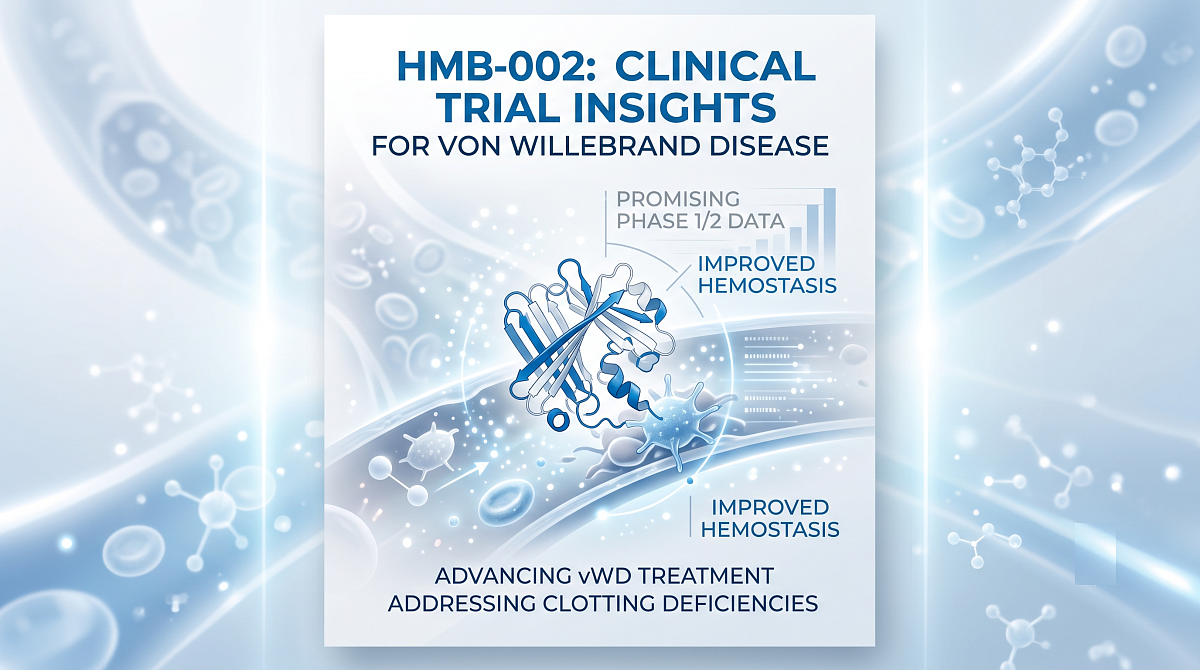
Hemab Therapeutics unveiled compelling early-stage Phase I/II data showing that its subcutaneous antibody HMB-002 substantially boosted VWF and Factor VIII levels, virtually eliminating treated bleeds in patients with Von Willebrand Disease.
Hemab Therapeutics proudly presented highly anticipated Phase I/II data stemming directly from its HMB-002 clinical program explicitly targeting Von Willebrand Disease at the prestigious ISTH 2026 Congress. The company officially reported excellent dose-dependent increases in endogenous VWF and Factor VIII entirely alongside a highly preliminary bleeding signal that, while strictly descriptive in its nature, strongly suggests the innovative subcutaneous antibody may massively reduce treated bleeds in a patient population dealing with substantial baseline disease burden.
In the highly monitored single ascending dose (SAD) portion of the critical VELORA Pioneer trial (NCT06754852), the specific 150 mg cohort (A3) successfully achieved at least 2.4-fold peak biological elevations in both VWF and FVIII, brilliantly accompanied by the absolute restoration of natural thrombin generation, a notable shortening of activated partial thromboplastin time, and a remarkably stable multimer distribution. Pharmacokinetic data clearly showed a predictable, dose-dependent increase in Cmax paired with prolonged duration, and the company proudly said the PK/PD profile robustly supports the immense potential for convenient monthly subcutaneous dosing.
Across all evaluated SAD cohorts, an impressive 8 out of 9 fully evaluable patients recorded absolutely zero treated bleeds entirely in the 28 days following a single dose. This translated to an incredibly low mean annualized treated bleed rate of just 1.6 compared heavily to an alarming pre-treatment baseline of 20.1, based on comprehensive bleed data collected over up to 5.5 months. Safety was universally characterized as extremely favorable: most treatment-emergent adverse events were strictly mild to moderate, absolutely no serious adverse events occurred, no severe events were ever attributed to HMB-002, and no thromboembolic events, injection site reactions, thrombocytopenia, or dangerous hypersensitivity reactions were clinically observed.
The highly respected VELORA Pioneer study is an open-label, dose-escalation Phase I/II trial actively enrolling adults suffering from VWD. The SAD portion was entirely not designed to definitively measure long-term efficacy, and the company explicitly and properly characterized the current bleeding observations as completely descriptive. Data were formally reported from exactly 9 evaluable patients, and no controlled scientific comparison was directly made. The amazing bleed rate reduction should inherently be interpreted cautiously specifically given the extremely small sample size, the naturally unblinded design structure, and the absolute absence of a concurrent control arm.
Biologically, HMB-002 is a highly specialized monovalent human antibody that precisely targets the C-terminal CK domain of VWF, effectively shielding the critical protein from rapid degradation and thereby naturally raising endogenous VWF and FVIII levels completely without replacing them exogenously.
This brilliant non-replacement approach heavily contrasts directly with the current accepted standard of care, which widely includes recombinant VWF replacement therapy with vonicog alfa (Vonvendi/Veyvondi). Vonicog alfa is officially approved for adults suffering with severe VWD and was heavily associated in a Phase III prophylaxis study with an impressive 91.5% reduction in spontaneous annualized bleeding rates entirely versus historical on-demand baselines. It additionally contrasts with the widely used plasma-derived VWF/FVIII concentrate wilate, which clearly demonstrated an 84.4% reduction in mean total annualized bleeding rate during prophylaxis in the WIL-31 Phase III study. Both of these currently approved, legacy therapies completely require invasive intravenous administration. Clinical experts note that cross-trial comparisons consistently remain extremely limited by vast differences in overall study design, testing duration, and specific patient populations.